Document AI and Workflow Automation: What Actually Ships in Regulated Work
By Huzefa Motiwala · Co-Founder & Chief Product Officer
Most document AI projects do not fail at the model. They fail at the layer underneath it, in the workflow around it, or at the audit conversation that happens six months later. The model is usually the part that works.
This is a map of the whole system: what each layer does, where each one breaks, and the order to build them in. It is written from production work in regulated environments, where being wrong quietly is worse than being wrong loudly.
One framing worth holding on to: these systems are judged on their worst output, not their average. A summariser that is excellent 95% of the time is a useful tool. An extraction pipeline that is excellent 95% of the time, feeding a financial system, is a liability, because nobody reviews the 95%. That asymmetry drives most of the design decisions below.
What document AI actually is
The phrase covers three separable things, and conflating them is the first mistake.
Extraction turns a document into structured data. Retrieval finds the right passage when someone asks a question. Workflow is what happens next: validation, approval, the write-back into the system that actually runs your operation. A tool that does one well will not do the others at all, and most procurement conversations confuse them.
The useful mental model: a document is not a file, it is a step in a process. Anything that treats it as a file will handle the straightforward majority and leave you the part that mattered.
One document, all the way through
The layers are easier to hold onto with something concrete. Take a supplier invoice arriving as a scanned PDF, which is about as ordinary as this gets.
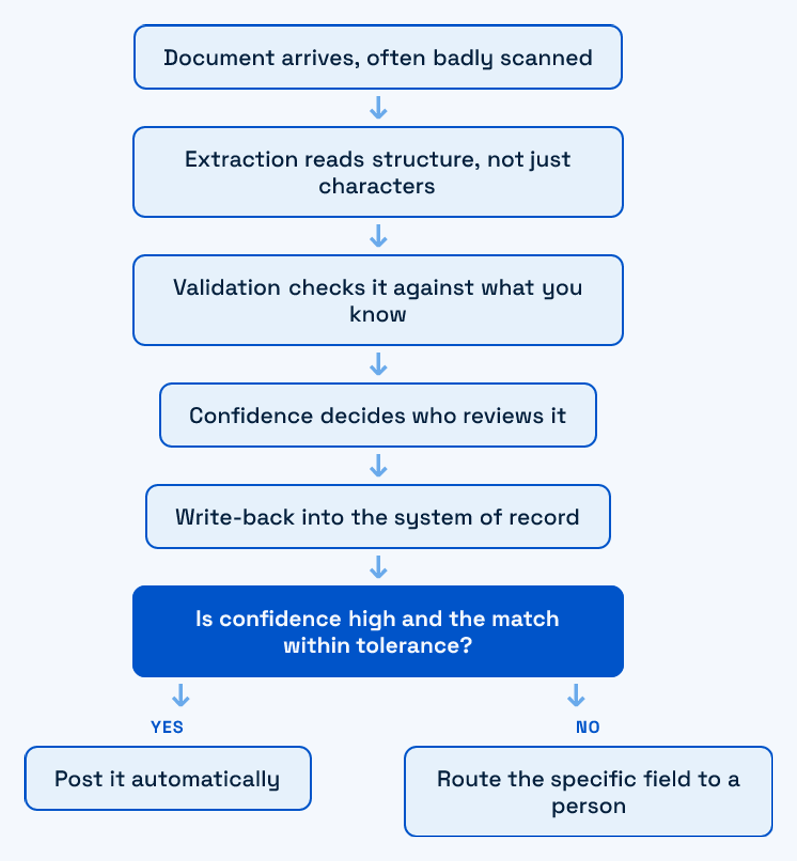
It arrives badly. Someone photographed a printout at an angle, or the scanner was set to fax quality, or it is a PDF that contains an image of a table rather than a table. Every downstream decision inherits whatever happens next.
Extraction reads it. Not just the characters, but the structure: which number is the line total and which is the unit price, which column header governs which column, whether the second page continues the table or starts a new one. This is where the expensive errors are born. A flattened table turns a five-line invoice into one line with a wrong total, and nothing about that output looks wrong.
Validation checks it against what you know. Does this supplier exist. Does the purchase order it references exist, and does the amount match. Is the tax arithmetic internally consistent. Most of this is rules rather than AI, and most teams underweight it because it is unglamorous. It is also the cheapest place to catch an error.
Confidence decides who sees it. High-confidence, matched, within tolerance: post it. Low confidence anywhere in the chain: route it to a person, with the specific field flagged rather than the whole document dumped in a queue. The difference between those two behaviours is most of the perceived quality of the system.
The write-back is the actual product. The value is not the extracted JSON, it is the posted entry in the system that runs your business, with a link back to the source document and a record of who or what approved it. Systems that stop at extraction leave the hardest integration work to whoever comes next.
Five steps, and only one of them is the part people call AI. This is the general shape, and it holds whether the document is an invoice, a permit application, a lab report or a delivery challan.
Three shapes these systems take
Almost every document AI deployment we have seen is a variation on one of three architectures. Knowing which one you are building prevents a lot of wasted argument.
The pipeline. Documents arrive, get processed in a fixed sequence, and land in a target system. Deterministic, easy to reason about, easy to audit. This is the right default for high-volume, well-understood document types, and it is what most teams should build first. Its weakness is variation: every new document type is new work.
The assistant. A person is doing the work and the system helps: pre-filling fields, surfacing the relevant clause, drafting the response. Throughput gains are smaller than full automation but so is the risk, and adoption is usually far better because nobody feels replaced. Good fit where volume is moderate and judgement is genuinely required on most items.
The agent. The system decides what to do next, calls tools, and loops until done. Genuinely useful for open-ended work that cannot be sequenced in advance. Also where reliability compounds against you, where cost becomes unpredictable, and where debugging is hardest. Worth reaching for when the first two shapes genuinely do not fit, and worth resisting before then.
| Shape | Fits when | Costs you |
|---|---|---|
| Pipeline | High volume, well-understood document types | Every new document type is new work |
| Assistant | Moderate volume, judgement needed on most items | Smaller throughput gain, but far better adoption |
| Agent | Open-ended work that cannot be sequenced in advance | Compounding unreliability, unpredictable cost, hardest debugging |
The common mistake is starting at the third because it is the most interesting. The common right answer is the first, with the second where humans need to stay.
The extraction layer is where most systems break
When a document AI system produces wrong output, the model is usually fine. It was handed corrupted input. A misread figure, a table whose structure was flattened, a two-column page read straight across: none of these raise an error, they just quietly become bad data.
This is the most under-invested layer in the stack and the one that determines everything downstream.
- Why enterprise document AI fails at the extraction layer, and what a robust pipeline handles that a naive one does not.
- OCR versus LLM-based processing: which fits fixed layouts, which fits variable ones, and why most production pipelines run both.
- A vendor evaluation template for testing extraction against documents that look like yours rather than the demo set.
Retrieval: finding the right passage, not a plausible one
Retrieval-augmented generation is the standard answer for querying a document corpus, and it is genuinely good. It also fails in a specific way that is easy to miss: it returns something confident and wrong rather than nothing.
The failure is almost never the language model. It is chunking that split a clause from its condition, embeddings that do not understand your domain vocabulary, or a query with no good answer in the corpus that the system answers anyway.
- Why RAG systems return wrong answers, and where in the retrieval path to look first.
- A production checklist: the gates worth passing before a RAG system touches real users.
Agents and orchestration: where reliability compounds
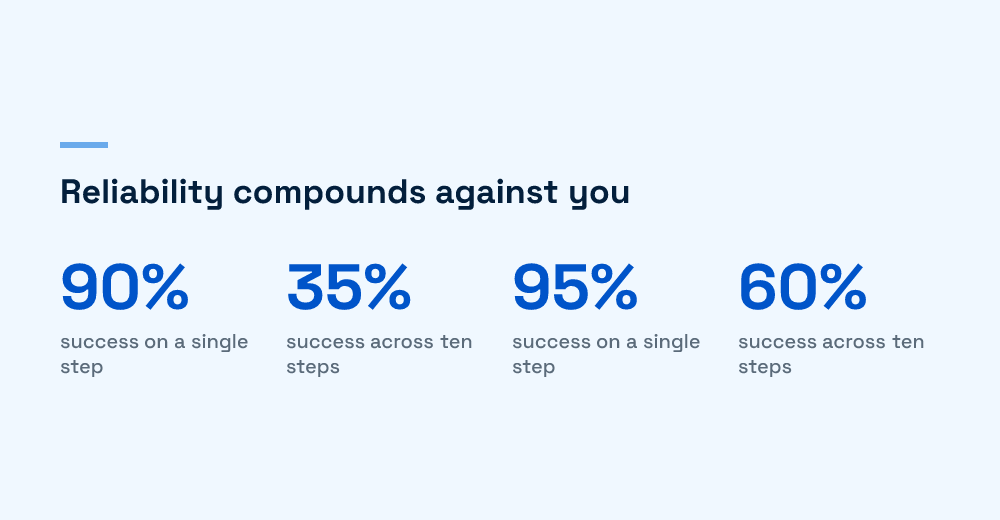
Multi-step agent workflows have an arithmetic problem that demos hide. Reliability multiplies. A step that succeeds nine times in ten is fine on its own and close to useless ten steps deep, because 0.9 to the power of ten is roughly a third.
That single fact should shape the design. Fewer steps, checkpointing between them, explicit handoff to a person when confidence drops, and enough tracing to reconstruct what happened.
- Tool-calling reliability across agent frameworks, and how retry and recovery differ between them.
- The hidden complexity in multi-agent orchestration: deadlocks, cascading failures and token bloat.
- Why benchmarks do not predict production, and what to test instead.
- Agent memory architecture, a week-one decision that sets a ceiling you hit much later.
Which model, and where it runs
The model choice matters less than teams expect and the deployment choice matters more. A smaller model close to the data often beats a larger one behind a network hop, and the total cost of ownership rarely resembles the sticker price of either.
The questions that actually decide it: does the data leave your estate, what latency does the workflow tolerate, and who maintains it in eighteen months.
- Open-source versus proprietary, and the costs that surface after launch rather than at procurement.
- On-device small language models, and what published benchmarks leave out.
- When a smaller model is good enough, and when the migration costs more than it saves.
- Self-hosting the whole thing, for teams where the data genuinely cannot leave.
Voice, when the document is a conversation
Plenty of operational input never arrives as a file. It arrives as somebody talking, often in a noisy place, often not in English. Voice agents are a document AI problem wearing different clothes: capture, structure, validate, write back.
The engineering constraint is unforgiving. Past roughly a second of latency the interaction stops feeling like a conversation, and everything in the pipeline competes for that budget.
- Multilingual voice agent architecture, including detection and fallback strategy.
- The latency budget, spent component by component.
- Knowing when the speaker has finished, which is harder than it sounds and where most demos cheat.
Compliance is a design input, not a review stage
In regulated work the question is never only whether the system is right. It is whether you can prove what it did, months later, to somebody who was not there.
Retrofitting that is expensive and sometimes impossible. Retention tiers, tamper-evident logging, access control and model governance are cheap when designed in and painful when bolted on. This is also the layer that decides whether a vendor is usable at all.
- Designing a document AI system that survives an audit: what auditors actually examine.
- What this looks like in practice: Zermit, where permit documentation had to be both automated and defensible to a regulator.
- Building regulatory requirements into the software rather than around it.
Where the human stays
The goal is not removing people. It is moving them from doing the repetitive work to deciding the ambiguous cases, and being explicit about which is which.
In practice that means confidence thresholds that route low-certainty output for review, approval steps where being wrong is expensive, and a logged trail for anything with a regulatory record. Systems that automate everything tend to get switched off after the first bad month.
- Where judgement still belongs in an automated workflow.
- Reading project documents at scale, and what still needs a person.
- What the Model Context Protocol actually solves when connecting models to internal systems.
What changed, and what did not
Two things are genuinely different from a couple of years ago. Vision-capable models handle layout and variable structure well enough that document types once needing bespoke templates are now tractable. And the price per operation has fallen far enough that generating several candidates and selecting between them beats engineering a single reliable pass, which quietly inverts a lot of received design wisdom.
What has not changed is more important. Models still fail confidently rather than loudly. Integration is still most of the work. Regulated environments still require you to prove what happened, and no model output is evidence on its own. Reliability still compounds badly across steps.
Most of the hard-won engineering practice in this space predates the current model generation and still applies.
How to tell whether it is working
Accuracy is the metric everyone asks for and the least useful one on its own. A system reporting 95% accuracy tells you nothing about which 5% it gets wrong, or whether it knows.
Four measures that carry more weight in production:
- Field-level precision, not document-level. A contract where 19 of 20 fields are right is not 95% correct if the wrong one is the payment term.
- Calibration. When the system reports low confidence, is it actually more likely to be wrong? An uncalibrated confidence score is worse than none, because it will be trusted.
- Failure visibility. What proportion of errors surface at the time rather than downstream. This is the number that separates an annoying system from a dangerous one.
- Escalation rate over time. If it is not falling, the system is not learning your edge cases. If it hits zero, someone has turned off the safety net.
Test on documents that look like your worst ones, not your cleanest. Vendor demos are run on the clean set, and the gap between the two is the entire project risk.
Where the cost actually sits
Model inference is usually the smallest line and the one every business case focuses on. The costs that matter are elsewhere.
Human review time is typically the largest ongoing cost, and it is the one you control through calibration. A system that flags too much is expensive; one that flags too little is dangerous. Getting thresholds right is worth more than a cheaper model.
Integration and maintenance is where the budget usually goes. Every system the pipeline touches has its own auth, its own schema, its own release cycle. This is ordinary software engineering, it does not get cheaper because there is AI elsewhere in the stack, and it is the line most business cases omit entirely.
The long tail of document types. The first format is a project. The twentieth is where teams discover whether they built a pipeline or a platform. If each new supplier format means a developer, the cost curve never flattens.
Rework from silent errors. The hardest to quantify and often the largest. Bad data that reached a downstream system three months ago costs far more to unwind than to have caught, which is the argument for spending on validation and observability rather than on a better model.
Build, buy, or the layer in between
Very few teams should build a document AI platform. Plenty should build one specific layer of it, and the distinction is usually where the money is either saved or wasted.
Buy the commodity. OCR, general extraction, storage, model hosting. These are solved, competitive, and cheaper than your engineering time.
Build where your process is the differentiator. The validation rules that encode how your business decides. The integration into the system nobody else runs. The approval chain your regulator expects. No vendor ships this, and configuring a platform to approximate it usually costs more than building the small thing that does it exactly.
The test that works: if every firm in your sector needs it, buy it. If it is the reason clients choose you, own it.
The order to build in
Most teams start with the model because it is the interesting part. The sequence that works is close to the reverse.
- Map the real process. Not the documented one. The gap between them is where automation projects die.
- Fix extraction. Everything downstream inherits its errors, and its errors are silent.
- Decide where humans stay before automating anything, so the thresholds are a design decision rather than an incident response.
- Add retrieval or agents only where a fixed rule genuinely cannot work. Most steps do not need either.
- Instrument it so that a wrong answer is visible the same day, not at the audit.
This is the shape of the work we do in document automation, workflow automation and RAG systems: usually a single workflow first, in six to ten weeks, with the audit trail built in from the start.