Why Your RAG System Returns Wrong Answers, and How to Fix Retrieval
By Huzefa Motiwala · Co-Founder & Chief Product Officer
TL;DR
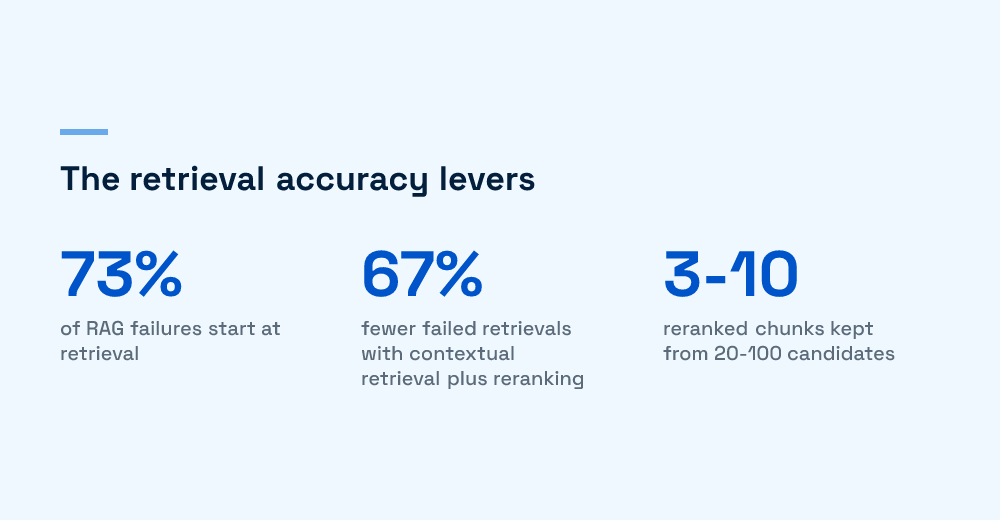
- Most RAG wrong answers are a retrieval problem, not a model problem: roughly 73% of enterprise RAG failures originate at the retrieval stage.
- Anthropic’s contextual retrieval cut failed retrievals by 49%, and by 67% when combined with reranking (top-20 failure rate 5.7% to 1.9%).
- Vector similarity is not relevance: a stale document at 0.92 cosine similarity can outrank the correct current document at 0.87.
- Two-stage retrieval fixes ranking: pull 20 to 100 candidates fast, then rerank with a cross-encoder and keep the top 3 to 10.
- Force grounding and citations so the model abstains when the retrieved context cannot answer, instead of guessing confidently.
If your RAG system returns confident, wrong answers, the model is usually not the problem. Retrieval is. When the wrong chunks reach the context window, even a strong model will write a fluent answer grounded in the wrong evidence. One analysis of enterprise deployments puts roughly 73% of RAG failures at the retrieval stage, not generation. Fix retrieval first, and most hallucinations disappear before you ever touch the prompt or swap the model.
We build compliance-grade RAG over enterprise documents, where a wrong answer is not a bad demo, it is a regulatory finding. In that work the pattern is consistent: teams reach for a bigger model when the actual defect sits three steps upstream, in how documents were chunked, embedded, ranked, and grounded. This is the pipeline where wrong answers are made.
Why does a RAG system return wrong answers when the model is fine?
Because retrieval decides what the model can see. A language model can only reason over the chunks you hand it. If that set is partial, stale, noisy, or merely adjacent to the question, the model produces a polished answer that feels evidence-based and is still wrong. Frontier models rarely abstain when the context is insufficient, and that overconfidence is not reflected in their stated certainty.
So the failure is rarely “the model hallucinated.” It is “the model faithfully summarised the wrong three paragraphs.” That distinction changes where you spend effort. We wrote about the same root cause in document pipelines: enterprise document AI fails at the extraction layer, not the model layer. Retrieval is the RAG equivalent of that extraction layer.
What are the five retrieval failure modes, and how do you fix each?
Nearly every wrong answer we diagnose maps to one of five failure modes. Each has a distinct symptom and a distinct fix, which is why “use a better model” so often changes nothing. Read the symptom, then apply the matching fix rather than guessing.
| Failure mode | Symptom you see | The fix |
|---|---|---|
| Bad chunking | Answer is partial or splices two unrelated facts | Contextual chunks, sensible size and overlap, small-to-big retrieval |
| Query-embedding mismatch | Retrieved docs look related but miss the intent | Query rewriting, hybrid keyword plus vector search |
| No reranking | Right document is retrieved but ranked below noise | Two-stage retrieval with a cross-encoder reranker |
| Ungrounded generation | Confident answer with no traceable source | Force citations, instruct the model to abstain |
| Stale index | Old policy returned with high confidence | Scheduled re-indexing, freshness metadata and filters |
How do you fix bad chunking?
Bad chunking is the most underdiagnosed cause of wrong answers. Split a document too aggressively and the fact you need lives half in one chunk and half in another, so the retriever fetches one and returns a partial, misleading answer. The fix is chunks that carry their own context, not just a fixed character count.
Anthropic’s contextual retrieval tackles this directly by prepending a short document-level summary to each chunk before embedding. That single change cut failed retrievals by 35% on its own, and 49% when paired with contextual BM25 keyword search. Practical tactics we use:
- Chunk on structure, not character count. Respect headings, clauses, and table boundaries so a chunk is a complete thought.
- Add overlap. A modest token overlap between chunks stops facts from being severed at the seam.
- Use small-to-big retrieval. Match on small precise chunks, then feed the model the larger parent section for full context.
- Attach metadata. Document date, source, and section let you filter before you rank.
For document-heavy stacks, chunking decisions interact with how you extract text in the first place. We cover that boundary in LLM-based document processing versus traditional OCR.
Does reranking actually improve retrieval accuracy?
Yes, and it is the highest-leverage fix for most teams. Vector search is fast but blunt: it flattens the query and each document into separate embeddings and compares them, so a document can score high on similarity while being wrong on intent. A cross-encoder reranker reads the query and each candidate together and scores true relevance, then reorders the shortlist.
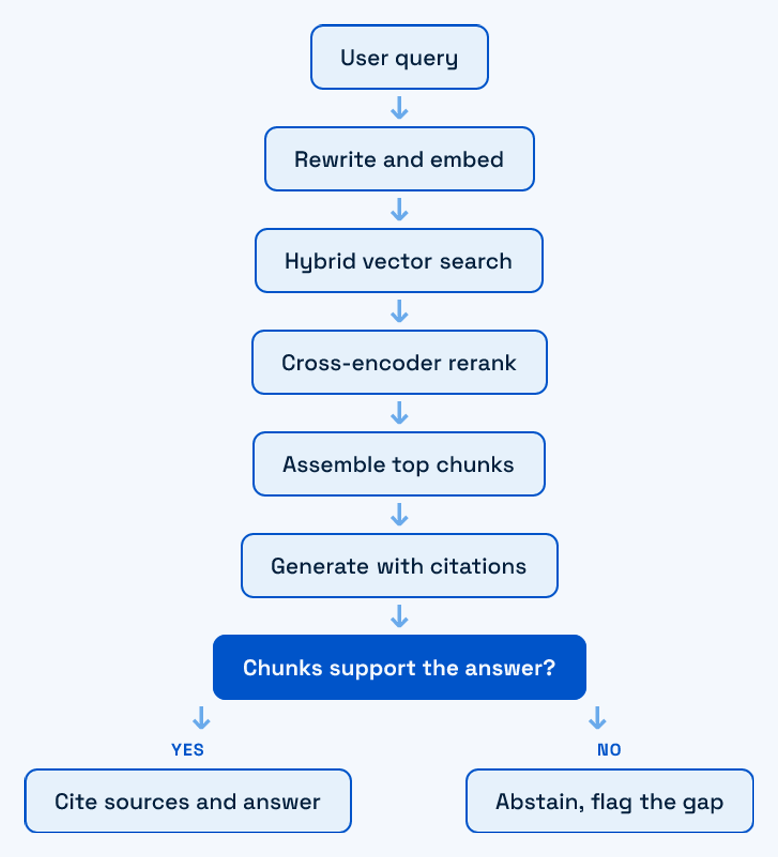
The pattern is two-stage retrieval. Stage one pulls 20 to 100 candidates with fast vector or hybrid search. Stage two reranks with a cross-encoder and keeps the top 3 to 10 for the model. Anthropic reports that adding reranking on top of contextual retrieval pushed the failure reduction to 67%, taking the top-20 failure rate from 5.7% to 1.9%. Reported benchmarks put cross-encoder reranking at a 10 to 25% accuracy gain on its own.
Reranking also solves a subtler problem. Models read best when the relevant fact sits near the start or end of the context and degrade when it is buried in the middle. Keeping only the top few reranked chunks means the right evidence is not drowned by ten near-misses.
How do you stop confident wrong answers?
Force grounding. The model should answer only from retrieved chunks, cite the chunk it used, and say it cannot answer when the context does not support one. Without this, a noisy retrieval set becomes a confident fabrication, because the model treats “adjacent” as “sufficient.” Grounding turns a silent wrong answer into a visible gap you can act on.
In regulated work this is non-negotiable. Every answer needs a citation an auditor can follow back to the source document, which is why we treat abstention as a feature, not a failure. We go deeper on this in designing a document AI system that survives a compliance audit, and on the checks to run before launch in our RAG implementation checklist.
The last failure mode is quieter than the rest: a stale index. A retriever will happily surface last year’s policy at 0.92 similarity while the current version sits at 0.87, and return the outdated answer with full confidence. Schedule re-indexing, stamp documents with freshness metadata, and filter on it at query time. Retrieval accuracy is not a one-time setup, it drifts, which is why AI features need different monitoring and metrics than a normal service.
None of these fixes require a bigger model, and that is the point. When a RAG answer is wrong, resist the reflex to swap the model. Walk the pipeline instead: chunk, embed, rank, ground, refresh. The defect is almost always in one of those steps, and each has a known fix. This is the same reason AI features fail in production even when the model works.
If your RAG system is returning wrong answers on enterprise documents and you cannot tell whether it is chunking, ranking, or grounding, that is worth a conversation, no pitch. We have diagnosed this pipeline enough times to spot the failing step quickly. A useful next step is our document AI audit template for pressure-testing a pipeline against its edge cases.
Frequently Asked Questions
Is a wrong RAG answer a retrieval problem or a model problem?
Usually retrieval. One analysis puts roughly 73% of enterprise RAG failures at the retrieval stage, not generation. If the retrieved chunks are partial, stale, or off-intent, even a strong model will produce a fluent answer grounded in the wrong evidence. Diagnose retrieval before you swap the model.
How much does reranking improve RAG retrieval accuracy?
Cross-encoder reranking typically adds 10 to 25% precision on its own. Anthropic found that reranking on top of contextual retrieval reduced failed retrievals by 67%, taking the top-20 failure rate from 5.7% to 1.9%. It is often the single highest-leverage fix.
Why does my RAG system retrieve the right document but still answer wrong?
Two common reasons. The right document may be ranked below noisier chunks, so it never makes the final context, which reranking fixes. Or the relevant fact is buried in the middle of a long context, where models read least reliably. Keep fewer, better-ranked chunks.
What chunk size should I use for RAG?
There is no universal number, but chunk on document structure rather than a fixed character count, add modest overlap so facts are not split at the seam, and consider small-to-big retrieval: match on small chunks, then pass the larger parent section to the model. Prepending document context to each chunk cut failed retrievals by 35% in Anthropic’s tests.
How do I stop a RAG system from giving confident wrong answers?
Force grounding. Instruct the model to answer only from retrieved chunks, cite the source it used, and abstain when the context cannot support an answer. Frontier models rarely abstain on their own, so make citations and “I cannot answer” a required output, especially in regulated work.