Human-in-the-Loop AI Workflow Automation: Where Judgment Still Belongs
By Huzefa Motiwala · Co-Founder & Chief Product Officer
TL;DR
- Human in the loop AI automation means the model does the work and a person signs off on the decisions that are costly, irreversible, or uncertain.
- Place the human at four points: confidence-threshold routing, an exception queue, sample-based QA, and a hard approval gate for irreversible actions.
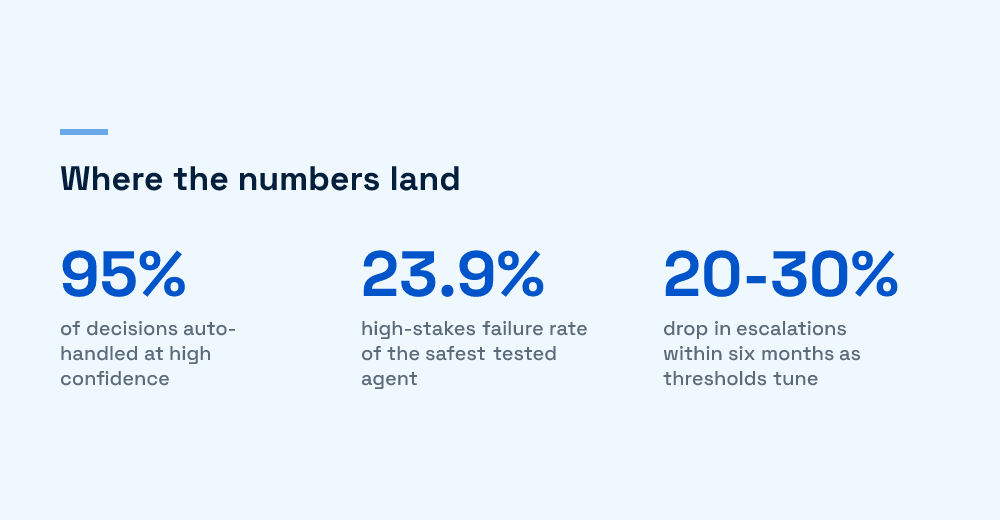
- One production pattern auto-handles the 95% of high-confidence decisions and routes the uncertain 5% to a qualified reviewer.
- Set the threshold from the cost of a wrong call: a $1,000 error tolerates roughly 80% confidence, a regulated or million-dollar decision needs 90% or higher.
- Even the safest tested LM agent failed 23.9% of high-stakes scenarios, so a soft notification is not oversight; the gate must block execution.
You have an agent that drafts refunds, or extracts fields from invoices, or triages support tickets. It is right most of the time. The question that stalls the rollout is not whether it works, it is where a person still has to sign off before the action commits. Get that placement wrong and you either drown a reviewer in low-value approvals or let the model quietly execute the one decision it should never have made alone.
Human in the loop AI automation is the answer to that placement problem. The model does the volume work; a person keeps decision authority over the actions that are costly, irreversible, or genuinely uncertain. This piece is a practitioner framework for where the human goes, not a case for slowing everything down. Full automation is the right call for a large share of a workflow. The skill is drawing the line in the right place.
What does human-in-the-loop AI automation actually mean?
Human-in-the-loop (HITL) means a person retains authority over defined high-stakes actions: the agent analyses, recommends, and proposes, but the commit waits for a human decision. It is distinct from human-on-the-loop (HOTL), where the agent acts autonomously and a person monitors and can intervene after the fact. The difference is about who holds the decision at the moment it executes, not about how closely anyone is watching.
That distinction matters because most teams reach for HITL as a blanket setting and then resent the friction. It is not a switch, it is a dial per decision class. The useful version routes by consequence:
- Autonomous: reversible, cheap, high-confidence work runs unattended.
- On-the-loop: the agent acts, a human reviews a sample or an alert after.
- In-the-loop: the agent pauses and cannot proceed until a person approves.
This is decision routing, not model monitoring. If you are tracking drift, latency, and accuracy dashboards, that is a related but separate discipline, and we have argued elsewhere that AI features need different monitoring metrics than conventional software. HITL is about who owns the call, not how you measure the model.
Where should the human sit in the workflow?
There are four reliable placements, and a real system usually uses more than one. Each answers a different failure mode.
1. Confidence-threshold routing
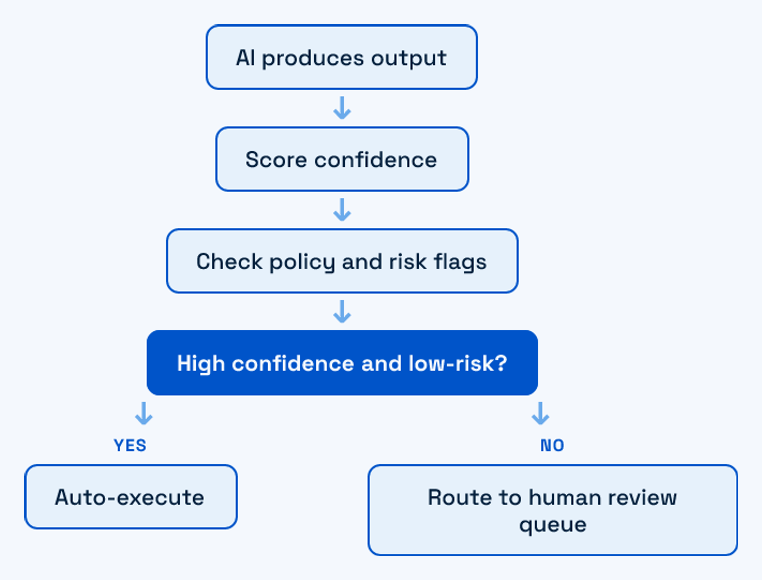
The agent scores its own confidence on every output. Above the threshold and low-risk, it executes; below it, the case drops into a review queue. One documented production pattern lets the AI handle the 95% of decisions where confidence is high and route the uncertain 5% to a qualified human. This is the workhorse pattern and the one most teams underbuild, because they never calibrate the number.
2. Exception queues
Low-confidence or novel inputs do not get guessed at; they get parked. A reviewer resolves the exception, and crucially that resolution becomes training data. ActionAI reports escalation rates falling 20 to 30% over the first six months across its deployments as the thresholds and classifiers learn from resolved cases. A queue that never shrinks is a signal the model, not the reviewer, needs work.
3. Sample-based QA
For high-volume, low-stakes work, reviewing everything defeats the point of automating. Instead you sample: audit a random slice of committed outputs, watch the error rate, and tighten the threshold if it drifts. This is oversight without a bottleneck, and it is where uncertain outputs and their interfaces matter, because a reviewer can only catch what the UI surfaces. We have written about designing interfaces around uncertain AI outputs for exactly this reason.
4. Approval gates for irreversible actions
Some actions get a hard gate regardless of confidence: refunds over a threshold, data deletion, outbound customer messages, contract terms, anything with real blast radius. The gate has to be enforced in code, not implemented as a notification the agent can talk past. A soft alert that lets the agent proceed without an explicit yes is not a control; it just looks like one in the demo.
Where is full automation actually fine?
Automate anything reversible, cheap to undo, and high-confidence. Formatting, tagging, classification into safe buckets, first-draft generation, data normalisation: put a human on none of it, and sample the output instead. The test is not “could this be wrong,” it is “if it is wrong, what does it cost and can we take it back.” A mislabelled ticket is a shrug; a wrongly issued refund is a loss.
The map below is the one we hand clients when a workflow gets carved up. It is deliberately blunt.
| Decision profile | Placement | Why |
|---|---|---|
| Reversible, cheap, high-confidence (tagging, drafts, formatting) | Automate | Cost of a mistake is near zero and undoable |
| Ambiguous, low-confidence, or novel input | Review queue | Needs judgment the model does not have yet |
| Irreversible, costly, regulated, high blast radius | Block until sign-off | Someone has to be accountable for the call |
The failure we see most is teams treating the middle and bottom rows as one. They send every uncertain case to the same slow approval path as the truly dangerous ones, the queue clogs, reviewers rubber-stamp to clear it, and the gate that mattered stops mattering. This is one of the quieter reasons AI features fail in production even when the model works: the routing, not the accuracy, is what breaks.
How do you set the confidence threshold?
Start from the cost of a wrong decision, not from a round number that feels safe. The rule of thumb we use, and one practitioner framework puts in print, scales the bar to the stakes: routine invoice extraction runs fine near 80%, a regulated compliance decision wants 92% or higher, and if a wrong call costs a million dollars you are in 90 to 95% territory. An error that costs a few dollars can tolerate a much looser bar.
Then hold the number honestly. Benchmarks flatter agents: on paper, agentic task accuracy has climbed fast, but controlled testing tells a harder story. In the ToolEmu sandbox, even the safest tested LM agent still failed 23.9% of high-stakes scenarios. That gap between benchmark and blast radius is the entire argument for keeping a person on the irreversible actions.
Why this maps to senior human review
Placing the human well is a design decision about trust, and users can feel where the seams are. Surfacing why an agent paused, and making the sign-off legible rather than a mystery modal, is part of the same problem as designing trust and feedback into AI-driven interfaces. When the loop is invisible, people either over-trust the output or route around it, and both erode the workflow you were trying to speed up.
This is how we build. AI does the accelerated delivery; a senior engineer holds the gate on the decisions that carry real consequence, and the automation is shaped so the machine handles volume and the person handles judgment. It is the same instinct behind our view that AI should not own architecture decisions, because it has no memory of what broke last time. The uncomfortable part is that placement is a per-workflow judgment, not a template, and it usually only becomes clear once you map where each decision can actually do damage. That mapping is often where the real UX challenges of putting AI in a core workflow surface.
If you are drawing this line in your own product and are not sure where the human belongs, that is a conversation worth having before you ship, not after. No pitch, just a working session on where your workflow can safely run unattended and where it cannot.
Frequently Asked Questions
What is the difference between human-in-the-loop and human-on-the-loop?
Human-in-the-loop means the agent pauses and cannot execute a defined action until a person approves it, so the human holds the decision at the moment it commits. Human-on-the-loop means the agent acts autonomously and a person monitors, reviews samples, and can intervene afterward. Use in-the-loop for irreversible or high-cost actions and on-the-loop for high-volume, reversible work.
How do you set a confidence threshold for routing to a human?
Start from the cost of a wrong decision rather than a default number. Routine, low-cost tasks like invoice extraction can run near 80% confidence, while regulated or high-value decisions want 92% or higher. If a mistake costs around a thousand dollars you can tolerate 80 to 85%; if it costs a million you need 90 to 95%. Then audit a sample of auto-committed outputs and adjust the threshold if the real error rate drifts.
When is full automation without a human safe?
Automate any decision that is reversible, cheap to undo, and produced at high confidence: formatting, tagging, classification into safe buckets, first-draft generation, and data normalisation. The test is not whether the output could be wrong but what a wrong output costs and whether you can take it back. Reserve human sign-off for actions that are irreversible, expensive, regulated, or have a large blast radius.
Is a notification to a reviewer the same as an approval gate?
No. A real approval gate is enforced in code: the agent physically cannot execute the action class without an explicit human yes. A notification the agent can proceed past is a soft control that looks like oversight but is not, and it fails audits in regulated settings because there is no record of genuine human authorisation. For irreversible actions, the gate must block execution, not just inform someone.
Does human review slow automation down too much to be worth it?
Only if you route every case through it. A well-designed system automates the high-confidence majority, samples the low-stakes work, and reserves human sign-off for the small slice of genuinely consequential decisions. In practice, ActionAI reports escalation rates falling 20 to 30% over the first six months as resolved cases retrain the thresholds, so the human load can shrink over time rather than growing.