React Server Components in Production: Where They Help and Where They Hurt
By Huzefa Motiwala · Co-Founder & Chief Product Officer
TL;DR
- React Server Components render on the server and never hydrate, so their code is omitted from the client bundle entirely.
- RSC helps most on data-heavy, read-mostly pages: it removes render-blocking waterfalls and drops heavy libraries like syntax highlighters out of the client bundle.
- RSC hurts when you pass non-serializable data across the boundary, wrap RSC-unaware client libraries, or read cookies in a layout and silently force dynamic rendering.
- Overusing ‘use client’ at the top of a tree cancels the bundle savings that motivated the move; keep it at the interactive leaves.
- On a large existing app, adopt RSC route by route, not as a rewrite. Start with a read-heavy page that has no client-only dependencies.
React Server Components (RSC) help most on data-heavy, read-mostly pages, where they cut the client bundle and remove render-blocking data waterfalls. They hurt on highly interactive surfaces, around client-only libraries, and anywhere a team treats them as server-side rendering with a new name. RSC is an architecture shift, not a config flag. On a large production app, it is a migration you stage route by route, not a switch you flip.
We modernise large frontends for teams that cannot afford a rewrite, and RSC lands in that same category. The teams that get burned are the ones expecting a free performance win. The teams that win pick one route, prove the model, and expand from there.
What actually changes when you adopt React Server Components?
Server Components run only on the server, produce a serialized description of the UI, and ship zero JavaScript for themselves. They do not hydrate. That is the whole point, and it is the part most teams miss. As Josh Comeau puts it, RSC is not a replacement for server-side rendering. SSR still turns your first render into HTML and hydrates the whole tree. RSC decides which components ever reach the client at all.
The mental model is two environments in one tree, not one environment in two places. The React docs frame the default as server, with 'use client' marking the exception at the leaves where interactivity actually lives. Dan Abramov’s React Conf talk makes the same case: you are writing one app that spans two computers.
If your team still reasons about components as “a thing that renders in the browser,” every RSC decision will feel arbitrary. Fix the model first. The cost of skipping that step shows up later as random 'use client' directives sprinkled to make errors disappear.
Where do React Server Components genuinely help?
RSC pays off when a page reads a lot of data, renders mostly static markup, and leans on heavy libraries the user never needs to interact with. Three concrete wins show up in production.
Bundle reduction on heavy, non-interactive UI
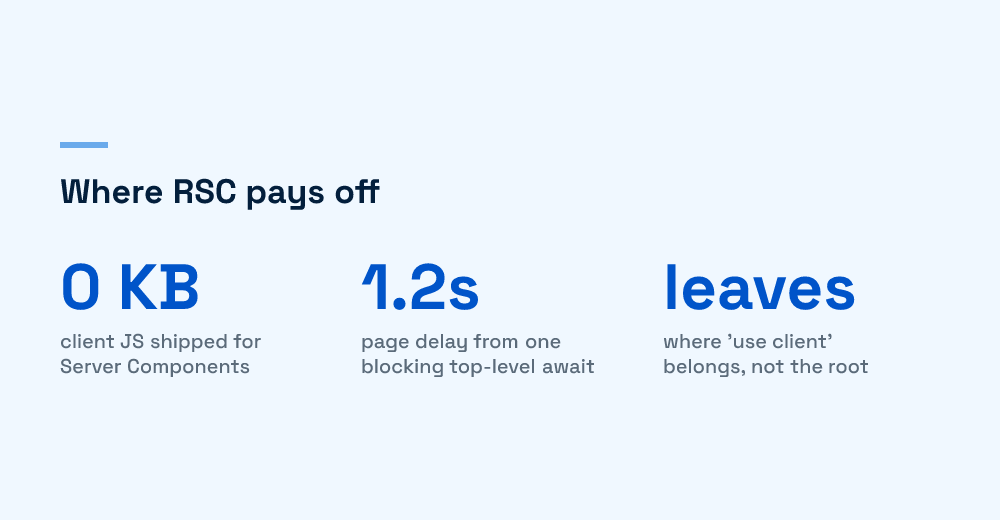
Because a Server Component’s code is never sent to the browser, libraries used only for rendering drop out of the bundle. A syntax highlighter, a markdown parser, a date formatter: none of that ships to the client if it runs in a Server Component. On data-heavy interfaces this is the single biggest lever, and it compounds with every heavy dependency you move server-side. It also relieves one of the root causes we cover in why large frontend applications become slow over time.
Killing client-side data waterfalls
Fetching on the client creates request chains: render, discover you need data, fetch, re-render, discover the next dependency. Moving fetches into Server Components lets them run close to the data and stream results as they resolve. This is the same class of problem we flag in common frontend performance mistakes in data-heavy web apps.
Read-mostly pages with a small interactive island
Dashboards, docs, product catalogues, content feeds: pages that are 90% display and 10% interaction are the ideal shape. You render the shell on the server and hydrate only the buttons, filters, and forms that need state.
Where do React Server Components hurt?
RSC hurts when the page is interactive-first, when it depends on libraries that are not RSC-ready, or when a small mistake at the boundary forces the framework into a slow path silently. These are the failure modes we see most.
The serialization boundary bites in production
Only serializable data crosses from server to client. Functions and class instances do not. The Next.js docs are explicit about this, but the error often surfaces only when a real payload hits the boundary, not in the happy-path demo.
Third-party client libraries and interactive forms
Anything using state, effects, context, or browser APIs stays a Client Component. A charting library, a rich text editor, a drag-and-drop grid: these do not become Server Components, and forcing the issue wastes days. Vercel’s own explainer frames a healthy app as using both together, Server Components for data and Client Components for rich interactivity. The honest position is to keep those libraries as deliberate client leaves and document why.
Caching and dynamic-rendering foot-guns
Reading cookies or headers inside a layout opts the whole subtree into dynamic rendering and disables static generation. A Server Component treated as a static template can also serve stale data after a write, because the cache was never invalidated. LogRocket documents cases where a single top-level await, such as an analytics call, delayed a page by 1.2 seconds by blocking the stream.
Overusing ‘use client’ cancels the benefit
The most common regression: a team marks a whole feature directory as client because a fix once required it. That re-hydrates everything below it and reintroduces the bundle weight RSC was meant to remove. Keep 'use client' at the leaves.
Here is the split we use to sort candidates before touching a route.
| Signal | RSC helps | RSC hurts |
|---|---|---|
| Page type | Read-heavy, mostly display | Interactive-first, form-heavy |
| Data | Fetched server-side, serializable | Non-serializable or client-owned state |
| Libraries | Render-only, heavy deps | Client-only, not RSC-ready |
| Rendering | Static or streamable | Per-request cookies in layouts |
| Team model | Understands server default | Reasons in “browser components” |
How do you adopt RSC on a large app you cannot rewrite?
You adopt RSC the way you modernise anything fragile: incrementally, one route at a time, with a rollback path. A full migration to the app router across a big codebase is a multi-quarter effort, and doing it as a big-bang rewrite is how these projects fail. The same logic drives our approach in how teams incrementally modernise large frontend codebases and frontend modernisation without rewriting everything.
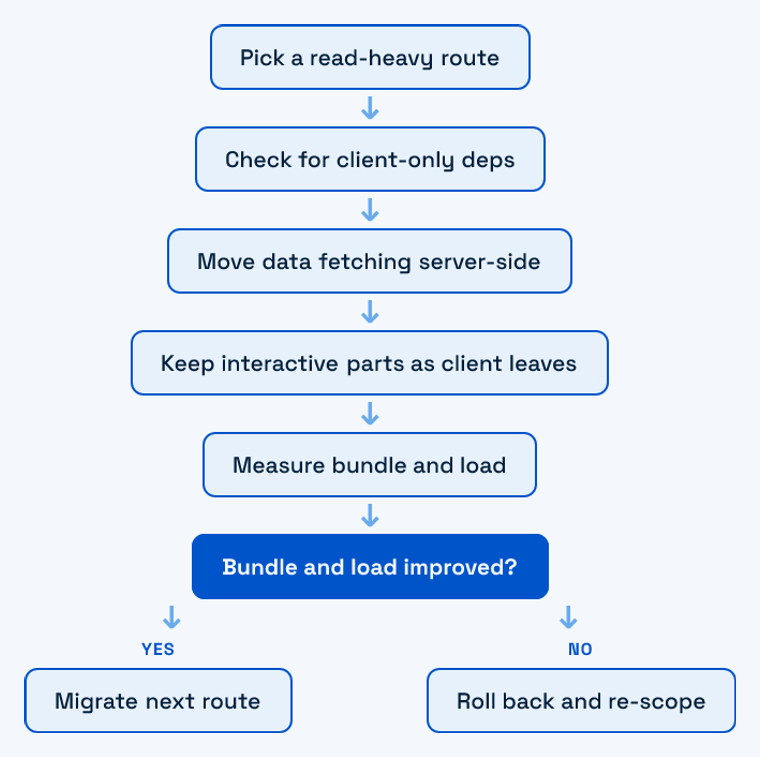
Start with a read-heavy route that has no client-only dependencies. Move its data fetching server-side, keep the interactive bits as client leaves, and measure the bundle and load change before touching the next route. Treat each migrated route as a bounded experiment, not a commitment to convert the whole app.
This staged path matters more on frontends that already carry debt. RSC will not fix a tangled component boundary; it will expose it. If your architecture is already at the edge, the questions in monolith vs modular frontend architecture come first. And RSC is not a one-time win either: keeping the server and client split clean is ongoing work, the same point we make in frontend performance optimisation is not a one-time task.
Adopted this way, RSC is a strong tool for the exact pages that hurt today. Adopted as a rewrite or a default, it becomes another migration your team is afraid to touch.
Frequently Asked Questions
Are React Server Components the same as server-side rendering?
No. Server-side rendering turns your first render into HTML and then hydrates the whole tree in the browser. Server Components run only on the server, ship no JavaScript for themselves, and never hydrate. They are complementary: SSR handles the initial paint, RSC decides which components reach the client at all.
When should you not use React Server Components?
Avoid them for interactive-first surfaces, anything depending on client-only libraries that are not RSC-ready, and cases where you need non-serializable data or client-owned state at that level. Offline-first or intermittently connected apps also fit poorly, because RSC assumes reliable server access at render time.
Do React Server Components actually reduce bundle size?
Yes, when used correctly. A Server Component’s code is never sent to the browser, so render-only libraries such as syntax highlighters or markdown parsers drop out of the client bundle. The saving disappears if you mark large parts of the tree as client components, which re-hydrates them and ships their code again.
What is the most common RSC mistake in production?
Overusing the ‘use client’ directive. Teams mark whole feature directories as client to make an error go away, which cancels the bundle and streaming benefits. The second most common is reading cookies or headers in a layout, which silently forces dynamic rendering and disables static generation.
Can you add React Server Components to an existing large app?
Yes, but incrementally. Migrate one read-heavy route at a time, move its data fetching server-side, keep interactive parts as client leaves, and measure before moving on. Treat each route as a bounded experiment with a rollback path rather than committing to a full rewrite of the codebase.