Why Your Next Hire Shouldn’t Be a Developer - It Should Be a Codebase Audit
By Huzefa Motiwala · Co-Founder & Chief Product Officer
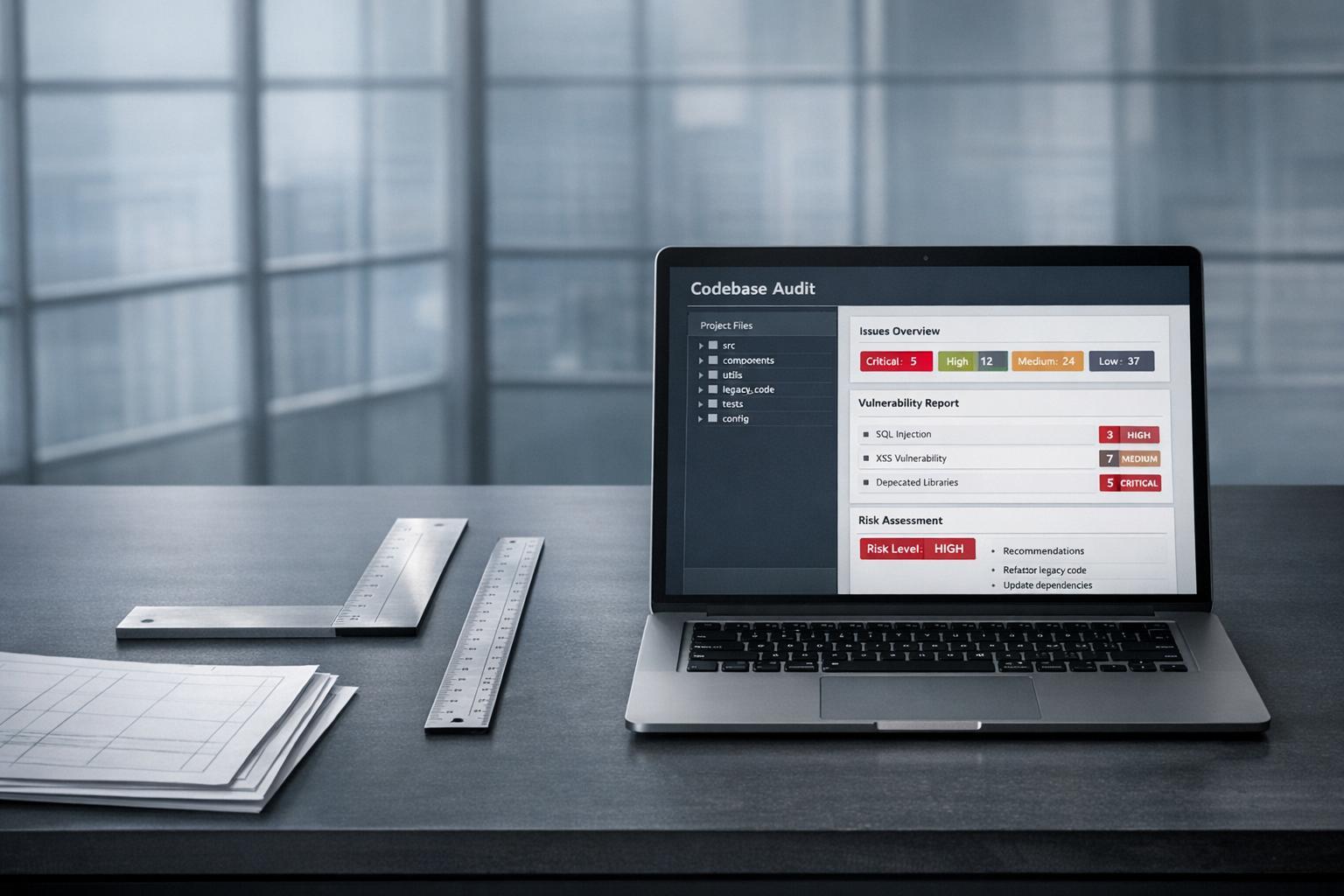
Your startup is growing, but your codebase might not be ready to handle the pressure. Hiring developers without first auditing your system can lead to wasted time, higher costs, and even catastrophic failures. A codebase audit helps identify critical flaws, security vulnerabilities, and technical debt before scaling, saving you 5-10x in repair costs and cutting maintenance budgets by up to 50%.
Here’s why an audit makes sense:
- Cost-effective: Audits cost $5,000-$10,000 compared to $120,000+ for a developer who may spend weeks untangling issues.
- Prevents disasters: Avoid breaches like Moltbook’s February 2026 incident, which exposed 1.5 million API keys.
- Faster onboarding: New hires ramp up in 2 weeks with a clean codebase, compared to 5 weeks with messy, undocumented code.
- Smarter hiring: Know whether you need a senior engineer, a short-term contractor, or a specialist.
Skipping an audit risks slowing growth, inflating costs, and exposing your startup to security threats. Audit first, hire wisely, and scale confidently.
Audit a Codebase Using AI
The Real Cost of Hiring Before You Audit
Bringing a developer on board without first auditing your codebase is like starting a home renovation without inspecting the foundation. You could end up spending $120,000-$150,000 annually (plus 1.4× overhead) to build on shaky ground [3]. This hidden technical debt doesn’t just slow progress - it inflates repair costs and stifles growth.
Technical Debt and Scalability Problems
Hidden technical debt eats up 60-80% of maintenance budgets, leaving little room for innovation [2]. Instead of focusing on new features, developers often spend their time troubleshooting, which can slow feature delivery by as much as 50% [2].
Scaling adds another layer of risk. A system that functions well for 100 users can crumble under the weight of 10,000 due to issues like unoptimized database queries or missing caching layers - problems that a proper audit would identify [2]. Lack of documentation further complicates things, stretching onboarding timelines from two weeks to as long as five as new engineers struggle with fragile code [2]. Shockingly, around 20% of files in a typical codebase account for 80% of software defects [4].
For companies relying on AI-generated code, the risks are even higher. AI tools often handle prompts in isolation, which can result in duplicate logic and conflicts [2]. A real-world example? One startup accidentally pushed hardcoded AWS credentials to a public repository, leading to over $50,000 in unauthorized charges from crypto miners [2]. Skipping an audit and trusting unexplained code can have serious financial consequences.
As these hidden flaws grow, the costs of reactive fixes spiral out of control.
The Price of Fixing Problems After They Break
Fixing issues after they’ve caused damage can be incredibly expensive. Addressing architectural flaws post-launch can cost 5-10 times more than catching them early [2]. Emergency rewrites and constant firefighting drain resources, with technical debt costing up to $42,000 per developer annually and consuming as much as 87% of maintenance budgets [4].
In comparison, a comprehensive codebase audit - typically costing $5,000 to $10,000 for 1-2 weeks of work [5] - is a small price to pay. An audit identifies vulnerabilities, broken components, and immediate priorities, giving you a clear roadmap before committing to a six-figure developer salary. Companies that actively tackle technical debt through audits can cut overall tech spending by 25-50% without reducing headcount [4].
"We’ll refactor later - famous last words right before another feature gets delayed, another developer rage-quits, or your app crashes in production."
- Alex Vasylenko, CEO, The Frontend Company [4]
The steep costs of reactive fixes make a strong case for prioritizing early audits.
Case Example: When Startups Are Forced to Rewrite
In May 2025, a security scan of 1,645 apps built on the Lovable platform revealed that 170 - roughly 10% - were leaking sensitive user data [2]. The culprit? A configuration error where users connected to Supabase without enabling Row Level Security (RLS). This basic oversight could have been caught with a standard audit [2].
Rebuilding a flawed codebase can cost anywhere from $50,000 to $500,000, depending on its complexity [2]. That’s a hefty price to pay for preventable mistakes. Worse, while you’re scrambling to fix these issues, competitors are rolling out new features and gaining market share. A codebase audit doesn’t just save money - it safeguards your runway and keeps your startup competitive.
What a Codebase Audit Actually Reveals
When it comes to managing the high costs of reactive fixes, a thorough codebase audit can be a game-changer. It pinpoints exactly where your codebase is vulnerable. By analyzing your system, an audit uncovers weaknesses, hidden risks, and potential failure points that might emerge as your system grows. Instead of relying on guesswork, an audit provides a clear map of architectural flaws, security gaps, and performance inefficiencies, transforming vague concerns into actionable steps.
What Gets Assessed in an Audit
A codebase audit focuses on four key areas:
- Architectural coupling: This identifies dependencies that force system-wide updates whenever changes are made, highlighting areas where your architecture might be too tightly intertwined.
- Technical debt hotspots: These include redundant logic, such as inconsistent date formatting or multiple authentication methods, which drain developer resources unnecessarily.
- Security vulnerabilities: Examples include hardcoded API keys for services like AWS or Stripe, as well as an overreliance on client-side security while backend endpoints remain exposed.
- Scalability bottlenecks: These are inefficiencies like poorly optimized database queries or missing caching mechanisms, which might perform fine under light usage but struggle under heavier loads.
Audits also expose issues like "AI architectural amnesia", where AI tools treat each prompt as an isolated task. This can lead to conflicting implementations, such as inconsistent state management throughout an application.
The findings from these assessments lay the groundwork for an AI-powered evaluation of your system.
How AI Tools Generate System Health Reports
Tools like AlterSquare’s AI-Agent Assessment can quickly analyze your codebase and produce detailed reports. These tools evaluate architecture, security, performance, and technical debt by scanning thousands of files in just a few hours. Unlike manual reviews, AI tools excel at spotting patterns and subtle issues that might otherwise go unnoticed. They also address the common "happy path" bias, which focuses on ideal scenarios while ignoring edge cases like database timeouts, high-frequency interactions, or malicious inputs. Once the scan is complete, experts step in to translate the technical findings into actionable strategies.
Traffic Light Roadmap: Sorting Issues by Priority
Once the audit findings are in, prioritization becomes crucial. The Traffic Light Roadmap organizes issues into three categories:
- Critical: These are high-priority issues, such as SQL injection vulnerabilities, exposed credentials, or race conditions, that require immediate attention.
- Managed: These include less urgent concerns like inefficient algorithms or insufficient error handling, which should be tracked and resolved over time.
- Scale-Ready: This category highlights code that’s already production-ready and capable of supporting future growth.
This roadmap ensures that the most pressing issues are addressed first, while less urgent fixes are scheduled. It also helps inform hiring decisions, whether you need a specialist to address architectural flaws or temporary support for managing a remediation backlog.
How to Prepare for a Codebase Audit
A successful codebase audit starts well before the actual review begins. Many founders wait until problems arise to initiate an audit. But the startups that gain the most insights treat preparation as an integral part of the process. By setting clear goals upfront, you can turn a generic review into actionable insights aligned with your growth or compliance objectives.
Set Clear Goals and Define the Scope
An audit without specific objectives often results in a report filled with findings but no clear direction. Before bringing in an auditor, identify the exact questions you want answered. Are you preparing for rapid growth and need to assess whether your architecture can scale? Do you need to validate AI-generated code from tools like Cursor or Claude Code that your team didn’t write? Or are you gearing up for investor due diligence, where third-party confirmation of your system’s reliability is critical?
Your goals will shape the scope of the audit. For example, if scalability is your focus, you might want to evaluate metrics like p95 Time to First Byte (TTFB), cache hit rates, and cost per 1,000 requests - metrics tied to the Traffic Light Roadmap approach [6]. If compliance is your priority, whether for SOC 2, HIPAA, or PCI, the audit should uncover gaps in areas like data classification and encryption [5][6].
Organize Documentation and Plan Your Budget
Auditors need context to work efficiently, so providing thorough documentation upfront is crucial. This includes README files, architectural decision logs, and system maps detailing services, data stores, and external dependencies [6]. The more prepared you are, the quicker auditors can focus on key issues rather than piecing together missing information.
Audits come with varying price tags based on their depth:
- AI-Agent Assessments start at $2,500 and provide a System Health Report with prioritized findings [5][7].
- A comprehensive audit with full human review costs between $5,000 and $10,000 and typically takes one to two weeks [5].
- Investment-grade due diligence for investors or acquirers ranges from $10,000 to $20,000+, covering risk ratings and IP licensing reviews [5].
If you’re on a tight timeline, expect to pay a 30-50% premium for expedited reviews [5].
Before granting access to your codebase, ensure a Non-Disclosure Agreement (NDA) is in place. Provide secure, time-limited repository access, and remove hardcoded secrets to allow auditors to focus on deeper architectural issues. It’s worth noting that automated tools can detect exposed API keys in public repositories in as little as 12 minutes [2]. Updating dependencies and setting up basic CI/CD pipelines beforehand can also streamline the audit process.
Use the Results to Shape Your Next Steps
Once you have the audit report, it’s time to turn findings into actionable priorities. Categorized results can guide hiring decisions. For instance, if the audit highlights tightly coupled architecture requiring system-wide updates, you’ll need a senior engineer to untangle dependencies - not a junior developer to add features. If critical security issues like SQL injection or exposed credentials are uncovered, you might need temporary specialists to address these vulnerabilities before expanding your team.
The audit also helps prioritize refactoring efforts. Instead of guessing where your technical debt lies, you’ll have a clear picture of which parts of your codebase are holding you back. Technical debt can slow new feature development by 50% and consume 60-80% of maintenance budgets [2]. With a roadmap in hand, you’ll know what needs immediate attention, what can be tackled later, and what’s already in good shape. This clarity allows you to allocate resources effectively, set realistic deadlines, and communicate progress to stakeholders.
Audit First vs. Hire First: Which Approach Works Better
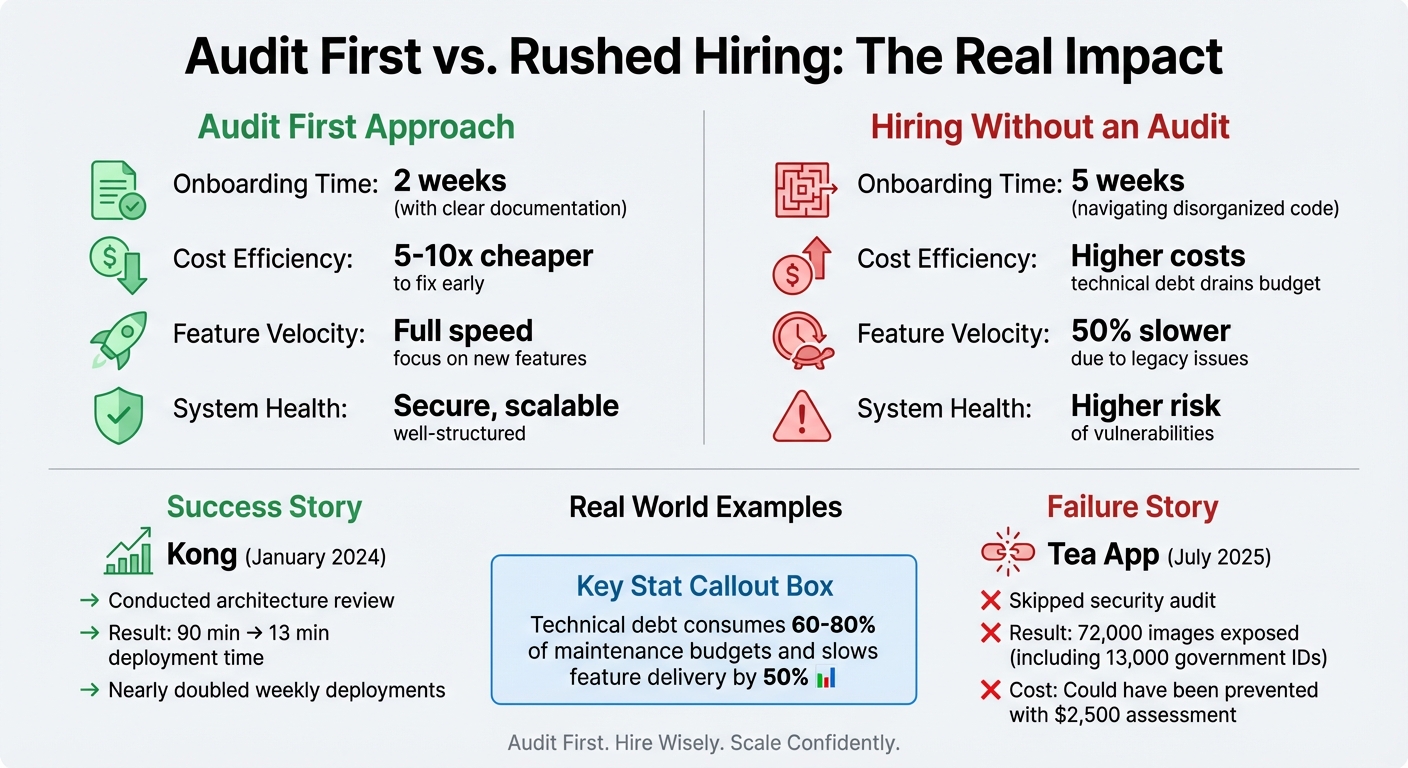
Codebase Audit vs Hiring First: Cost and Time Comparison
Side-by-Side: Audit First vs. Rushed Hiring
When it comes to managing your codebase, the choice between auditing first or jumping straight to hiring has a ripple effect on everything - onboarding, costs, and long-term system performance. Here’s the reality: hiring into an unaudited codebase can slow onboarding significantly. New developers might take up to five weeks to get up to speed, compared to just two weeks with a clean, well-audited system[2]. Why? Because messy, undocumented code creates a maze that even AI tools struggle to simplify.
Addressing problems early is also much more cost-effective. Fixing issues before launch can be 5-10 times cheaper than waiting until they cause damage[2]. On top of that, technical debt can slash feature delivery speed by nearly 50%, leaving teams scrambling to keep up[2].
| Aspect | Audit First Approach | Hiring Without an Audit |
|---|---|---|
| Onboarding Time | About 2 weeks with clear documentation | Around 5 weeks navigating disorganized code |
| Cost Efficiency | Early fixes are significantly cheaper | Higher costs due to technical debt eating into the budget |
| Feature Velocity | Teams focus on building new features | Development slows by roughly 50% due to legacy issues |
| System Health | Secure, scalable, and well-structured architecture | Higher risk of vulnerabilities and inefficiencies |
Real-world examples highlight the stakes. In January 2024, Kong revamped its architecture after a thorough review, switching to a micro-frontend design. This move cut pull-request-to-production time from 90 minutes to just 13 minutes, nearly doubling their weekly deployments[2]. On the flip side, Tea - a safety-focused dating app - skipped a security audit in July 2025. The result? A misconfigured Firebase instance exposed 72,000 images, including 13,000 government IDs, and 59,000 private messages. A simple $2,500 AI-Agent Assessment might have prevented this breach[2].
These examples make one thing clear: auditing first lays the groundwork for smarter, more efficient hiring and development.
How to Hire Smarter After an Audit
Once you’ve audited your codebase, you’re not just fixing issues - you’re also identifying the exact skills your team needs. For instance, if your Traffic Light Roadmap flags tightly coupled architecture as a critical problem, hiring a senior engineer to untangle dependencies makes far more sense than bringing on a junior developer to add features. Similarly, if security risks like SQL injection vulnerabilities or exposed API keys are uncovered, you might need a temporary security expert to plug those gaps before scaling your team further.
"The moment you cannot clearly explain the code you are shipping, it likely does not belong in a live production system." - Paul Courage Labhani, Frontend Developer[2]
An audit streamlines hiring by focusing on stabilization over expansion. Instead of making ad hoc hires, you can assemble a focused Core Squad to tackle technical challenges head-on[1]. This deliberate approach ensures you’re building on a solid foundation rather than patching up cracks as you go.
Conclusion
Hiring a developer might seem like the obvious move when you’re scaling, but taking the time to audit your codebase first can be a game-changer. Fixing architectural or security issues before launch is far more cost-effective - up to 5-10 times cheaper than addressing them after deployment. Plus, technical debt can swallow a massive 60-80% of your maintenance budget[2]. Tackling these problems early frees up resources you can invest in growth.
Beyond saving money, an audit helps you hire smarter. Instead of bringing in a developer who might spend most of their time untangling existing issues, you’ll have a clear understanding of the skills your project truly needs. Whether it’s a senior engineer to restructure complex architecture or a security expert to fix vulnerabilities, you’ll be making precise, informed hiring decisions.
Skipping an audit comes with real risks. Small and medium-sized businesses account for 43% of all data breaches, and the average breach costs a staggering $4.45 million[2]. When foundational security issues are ignored, the consequences can be devastating. History has shown that even a modest investment in a code audit can prevent these costly mistakes.
If you’re ready to stop patching cracks and start building on a solid foundation, AlterSquare’s AI-Agent Assessment is a smart next step. With their System Health Report, you’ll uncover vulnerabilities, architectural flaws, and areas of technical debt. Their Traffic Light Roadmap prioritizes these issues, so you know exactly where to focus first. And with guidance from the Principal Council, you’re not just fixing problems - you’re creating a roadmap for sustainable and confident growth.
Audit first. Hire wisely. Scale with confidence.
FAQs
When is the right time to run a codebase audit?
The ideal moment for a codebase audit is either early in the development process or right before scaling up. This approach helps identify hidden risks, inefficiencies, and technical debt that might otherwise spiral into expensive problems later. Tackling these core issues early on sets the stage for smoother growth and a healthier system overall.
What should I give an auditor before they start?
To ensure a thorough and effective review, provide the auditor with the complete codebase. This includes:
- Source files: All files containing the actual code.
- Configuration files: Any settings or parameters critical to the application’s operation.
- Environment variables: Details on environment-specific settings.
- Relevant documentation: Clear and detailed documentation to help the auditor understand the system.
By sharing these elements, you equip the auditor with everything they need to conduct a comprehensive evaluation.
How do I turn audit findings into a hiring plan?
To turn audit findings into a solid hiring plan, start by breaking down the data to identify skill gaps, risks, and areas for improvement. Pay special attention to pressing concerns like security vulnerabilities, architectural flaws, or maintainability issues. From there, prioritize hiring specialists who have the knowledge and experience to tackle these challenges head-on. Use the audit as a guide to outline the specific roles and skill sets required. This approach ensures your hiring efforts directly support the long-term health and scalability of your systems.