Build Startups 5x Faster: AI-Powered Product Roadmap
By Taher Pardawala · Co-Founder & Chief Executive Officer
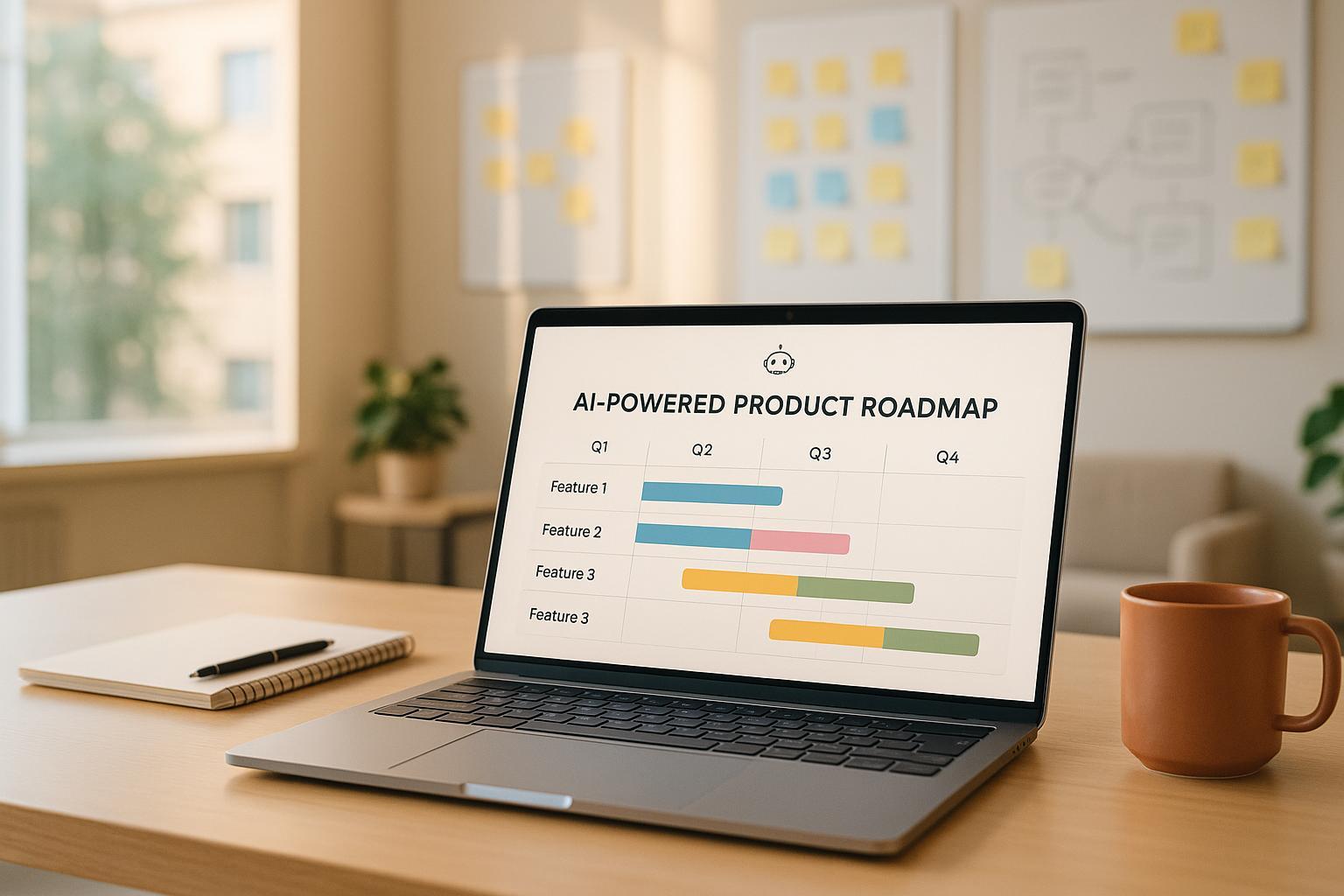
Startups thrive on speed, innovation, and adaptability. Traditionally, taking a startup from an idea to a fully functional product took months, if not years. However, the integration of artificial intelligence (AI) into product development workflows has rewritten the rules of the game. In this article, we’ll explore how AI is revolutionizing the startup journey, compressing timelines, and unlocking new levels of efficiency and creativity. Drawing insights from a conversation with Richard Abi Chahal, founder of Purple Brain, we’ll walk through the transformative impact of AI on building and scaling startups.
The Shift from Traditional to AI-Accelerated Product Development
Building a startup used to involve a labor-intensive process that spanned several months:
- Empathy and Market Research: Gathering assumptions, analyzing competitors, and conducting extensive online research could take weeks.
- Validation: Interviews, UX research, surveys, and testing to confirm assumptions often lasted six weeks or more.
- Prototyping: Designing the user interface, creating wireframes, and refining visuals typically required several months.
- Development: Coding and building an MVP (Minimum Viable Product) took another few months.
The traditional approach often demanded heavy investments in time, money, and manpower - resources that early-stage startups rarely have in abundance. With AI, this process is being condensed into mere weeks. Richard Abi Chahal explains, "What used to require 4-6 months can now be achieved in 2-3 weeks, thanks to the power of AI-driven tools."
How AI Transforms the Startup Journey
1. Automating Market Research
AI tools like Perplexity AI and Gemini have revolutionized the market research phase. Instead of spending weeks scouring the internet, founders can now leverage AI to generate comprehensive reports in minutes. By inputting prompts about their idea, founders can gain insights into market size, competition, customer pain points, and underserved opportunities.
For example, Richard describes how he used AI to validate an idea for a dog park finder app in NYC. In under 45 minutes, AI tools provided a detailed market research report, including demographic data, potential revenue models, and even competitor analysis. While the AI does 80% of the heavy lifting, founders still play a crucial role in synthesizing and validating the information.
2. Speeding Up Validation
Validation, once a time-consuming step, is now faster and more dynamic with the aid of AI. Founders no longer need to conduct extensive surveys or interviews. Instead, AI enables them to:
- Analyze User Insights: Tools can process transcripts of interviews or surveys and derive actionable insights in seconds.
- Iterate Faster: By generating quick prototypes, founders can directly test solutions with users rather than relying solely on theoretical feedback.
As a result, startups can test their assumptions with real-world solutions in days rather than weeks.
3. Prototyping in Hours, Not Weeks
AI-powered design tools like Stitch, Figma, and Pick My Eye have drastically reduced the time required to create prototypes. Founders can now generate professional-quality user interfaces (UI) with simple prompts, bypassing the need for a dedicated design team in the early stages.
Richard demonstrates this with the dog park app concept, where he used AI to create three core app screens - home page, search results page, and individual park details - in a matter of minutes. These prototypes can then be refined in tools like Figma or presented directly to potential users for feedback.
4. AI and Low-Code Development
Platforms such as Replit, Lovelace, and Bold allow founders to turn prototypes into functional MVPs quickly. With the help of AI, even non-technical founders can build initial versions of their product. While these tools may not produce production-ready code, they significantly shorten the time-to-market and enable faster iterations.
For example, Richard used AI-generated prompts to develop a functional MVP of the dog park app and showcase dummy data. This allowed him to test the product concept with prospective users without investing heavily in development resources.
5. Optimizing Product-Market Fit
AI empowers founders to experiment, analyze, and iterate toward product-market fit more effectively. By continuously processing user feedback, support tickets, and analytics, AI tools enable startups to:
- Customize onboarding journeys tailored to different customer personas.
- Identify gaps in the user experience and suggest improvements.
- Derive actionable user stories directly from customer feedback.
As Richard explains, "Product-market fit requires continuous experimentation and adjustment. With AI, you’re able to make better-informed decisions faster and maintain product-market fit even as you scale."
Building a Defensible Competitive Edge with AI
One common concern is whether widespread access to AI tools will level the playing field and dilute competitive advantages. Richard argues that expertise, decision-making, and experience remain critical differentiators. "AI can empower founders, but it’s still the human element that drives success", he asserts. Founders who combine AI with deep domain knowledge and strategic decision-making will remain ahead of the curve.
Furthermore, startups can build defensible moats by integrating AI into their core operations, such as creating customized workflows, automating customer interactions, or leveraging unique datasets for enhanced insights.
Step-by-Step Workflow Example: From Idea to MVP in Under an Hour
Richard shared a practical example of how to validate a business idea using AI tools:
- Conduct Market Research:
- Input a prompt into Gemini to generate a market analysis, including demand, competition, and potential revenue streams.
- Export the findings to a Google Doc for further synthesis.
- Generate a Prototype:
- Use Stitch with AI-generated prompts to design key app screens.
- Save the designs as images or import them into Figma for additional refinement.
- Build a Functional MVP:
- Use platforms like Replit, Lovelace, or Bold to develop a working web app based on the designs and prompts.
- Integrate dummy data for user testing.
- Test and Iterate:
- Present the MVP to potential customers, gather feedback, and refine the product based on insights.
This end-to-end workflow showcases how startups can leverage AI to transform an abstract idea into a tangible, testable product with minimal investment.
Key Takeaways
- AI Compresses Timelines: What once required 4-6 months now takes as little as 2-3 weeks when using AI tools.
- Market Research is Faster: AI tools like Perplexity and Gemini automate 80% of market research, allowing founders to focus on analysis.
- Prototyping Made Simple: Tools like Stitch and Figma enable quick UI creation, reducing the need for extensive design resources.
- Low-Code Development Accelerates MVPs: Platforms like Replit and Lovelace make it easier for non-technical founders to build functional prototypes.
- Maintain Product-Market Fit: AI helps startups continuously analyze data, test hypotheses, and refine their products to match evolving customer needs.
- Experience Still Matters: While AI democratizes access to tools, expertise and strategic decision-making are critical for maintaining a competitive edge.
- Innovation at Scale: AI enables startups to test and iterate faster, bringing products to market with unprecedented speed.
Conclusion
The integration of AI into the startup ecosystem has opened up new possibilities for founders to innovate faster and with greater precision. By automating repetitive tasks, enhancing decision-making, and enabling rapid experimentation, AI is empowering startups to launch and scale with confidence. However, the human element - experience, creativity, and strategy - remains irreplaceable. For ambitious founders willing to embrace AI, the future is brimming with opportunities. The only question is, how will you leverage this transformative technology to build your next big idea?
Source: "Building Startups at AI Speed - 5x Faster Product Development" - Disambiguation, YouTube, Aug 12, 2025 - https://www.youtube.com/watch?v=rifijLCqfe8