
Why IFC5 Changes the Economics of Building Construction SaaS on Open Standards
Huzefa Motiwala May 19, 2026
The construction industry loses $15.8 billion annually in the U.S. due to IT inefficiencies, with 3.1% of project budgets wasted on software incompatibilities. IFC5, the latest data standard from buildingSMART International, promises to cut these losses by simplifying integration, reducing costs, and enabling faster development for SaaS platforms.
Here’s what makes IFC5 different:
- JSON-Based Schema: Replaces the outdated EXPRESS format, making integration faster and cheaper.
- Modular Design: Developers can load only the components they need, cutting implementation time from months to days.
- Expanded Scope: Supports not just BIM but also GIS, point clouds, and analysis workflows.
- Cost Savings: Open standards reduce licensing fees, saving companies up to 20% on software expenses.
For SaaS developers, this means lower costs, faster deployment, and new opportunities to offer feature-specific pricing and collaboration models. IFC5 isn’t just a technical upgrade – it’s a smarter way to build construction software.
Driving IFC 5 Alpha Forward with usBIM ifc5 – a Living Testbed for Next Gen openBIM
sbb-itb-51b9a02
The Problems Construction SaaS Faces Without IFC5
Without IFC5, ongoing integration and data issues not only drive up costs but also slow down progress, making a strong argument for its adoption.
The Hidden Costs of Fragmented Data Standards
Sticking with older IFC versions or proprietary schemas isn’t just a hassle – it’s expensive. For instance, the outdated, STEP-based architecture of IFC4 forces developers to work with the entire schema, even when only a small portion is needed. This can add months to integration timelines [1].
IFC files are also notoriously bulky – 5 to 10 times larger than their native counterparts. This puts a strain on network infrastructure, slows down loading times, and complicates data handling [6]. And as models move between tools, there’s a real chance of losing critical information like fire ratings, material details, or structural load values during exports [6]. To mitigate this, custom mappings are often created, but these mappings are fragile and require constant updates whenever schemas change.
Ultimately, these data inefficiencies lead to higher costs and reduced system performance, creating a ripple effect throughout the development process.
How Poor Interoperability Hurts Your Bottom Line
These hidden inefficiencies translate directly into financial challenges. Construction software development already costs about three times more than typical SaaS development, largely due to the complexities of BIM, offline functionality, and legacy ERP integrations [5]. Add fragmented data standards to the mix, and costs climb even higher. Proprietary licensing fees, for example, are significantly more expensive than IFC-based solutions [3].
When engineering teams are bogged down with maintaining custom connectors and fixing data translation issues, they have less time to focus on building new features. This isn’t a minor issue – 43% of firms report ongoing struggles with proprietary system interoperability [3]. As BIM Business aptly states:
"If it’s your data, you should be able to open it, use it, reuse it, and connect it to whatever systems you choose – now and in the future." – BIM Business [7]
How Integration Problems Limit Pricing and Growth
Beyond the direct financial impact, integration challenges stifle growth opportunities. Engineering teams that spend their time maintaining integrations often can’t focus on pricing innovations or expanding product capabilities. Data migration projects, for instance, frequently exceed budgets by 30% and timelines by 41% [3].
For SaaS companies in the growth stage, these obstacles limit the ability to scale or branch into new workflows. This can lead to a narrowly focused product that struggles to meet the broader needs of the market.
How IFC5 Changes the Cost Structure of SaaS Development
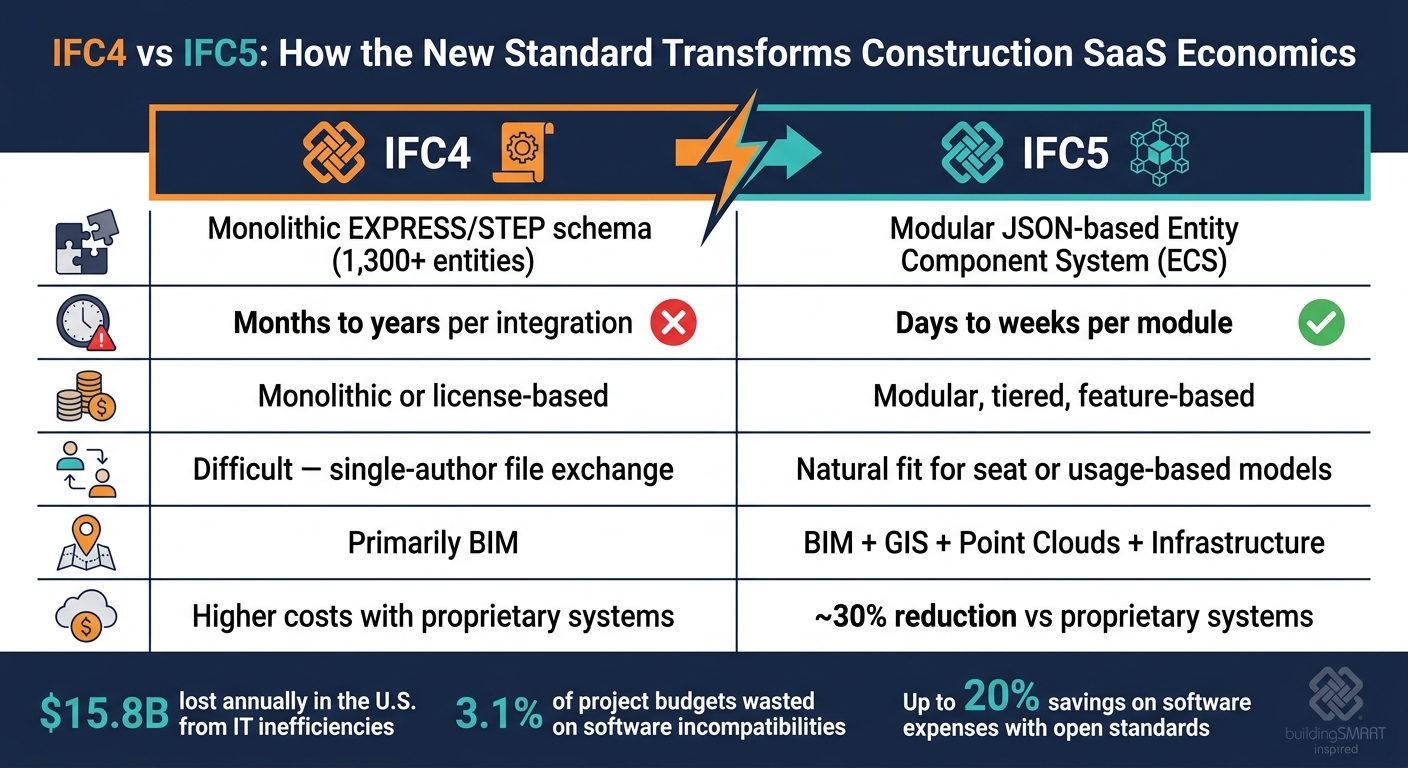
IFC4 vs IFC5: Cost & Development Impact for Construction SaaS
Older standards often result in bloated files, fragile connectors, and lengthy integration cycles. IFC5 addresses these inefficiencies, significantly cutting costs.
Cleaner Data Models and Improved System Interoperability
IFC5 tackles these challenges by reimagining the core data architecture. Unlike IFC4’s monolithic STEP-based schema with over 1,300 entities, IFC5 adopts a modular, JSON-based structure built on an Entity Component System (ECS). This allows developers to implement only the components they need, reducing integration time from months to just days [1]. Since JSON is widely used in modern development stacks, onboarding engineers is simpler and less expensive compared to the EXPRESS schema.
Additionally, IFC5 resolves much of the ambiguity that plagued earlier versions by establishing clear, standardized ways to represent data [1]. This clarity minimizes bugs, reduces the need for emergency fixes, and ensures smoother, more predictable development cycles.
Comprehensive Lifecycle Coverage for Construction Projects
One of IFC5’s overlooked strengths is its extended scope. While IFC4 primarily served as a BIM standard, IFC5 supports GIS, point clouds, and analysis workflows alongside traditional building data [1]. This eliminates the need for separate connectors, cutting costs and enabling a unified data approach. Developers no longer have to build or license additional integrations for tasks like site planning, environmental analysis, or facility management.
Platforms built on IFC5 can now support a construction project from the initial site assessment through design, construction, and long-term operations – all within a single data model. This continuity not only reduces costly errors during project phase transitions but also creates opportunities to reach new customer segments and introduce varied pricing tiers without requiring separate product lines.
Optimized for Cloud-Native and API-First Architectures
IFC5 aligns seamlessly with modern SaaS infrastructure, directly addressing earlier inefficiencies. Its component-based loading model allows applications to request and process specific data fragments on demand, avoiding the need to load entire building models into memory [1]. This approach reduces server strain and simplifies scaling in multi-tenant environments.
By shifting to client-side parsing – using tools like IFC.js to process BIM data directly in the browser – backend loads decrease further, enhancing responsiveness for users [2]. Additionally, IFC5’s compatibility with Universal Scene Description (USD) principles for managing large-scale models and incremental updates [1] helps reduce cloud infrastructure costs by approximately 30% compared to proprietary systems [3]. This cost advantage grows as platforms scale.
"The principle of IFC 5 is that multiple users contribute pieces of data to the overall dataset." – Léon van Berlo, Technical Director, buildingSMART International [1]
This distributed, multi-author data model is perfectly suited for multi-tenant SaaS platforms. It enables concurrent users from different organizations to collaborate on shared datasets without overwriting each other’s work. These cloud-native efficiencies provide a strong foundation for building the next generation of SaaS platforms around IFC5.
How to Architect a SaaS Platform Around IFC5
Core Architecture Patterns for IFC5-Based Platforms
IFC5’s modular and component-based design aligns naturally with a microservices architecture. This setup allows key IFC functionalities – like geometry processing, data validation, and model coordination – to operate as independent, scalable microservices. By isolating these functions, development becomes more streamlined, and operational costs are reduced. Given the larger file sizes associated with IFC5, scaling only the services under heavy load becomes critical for managing costs effectively.
Two architectural patterns stand out as particularly effective. First, asynchronous processing with tools like Kafka or RabbitMQ is ideal for long-running tasks such as parsing IFC files, detecting clashes, or federating models. These tasks can be processed in the background without holding up the main application. Second, using stateless components – with systems like Redis to manage session data – enables horizontal scaling during periods of high demand. It’s also crucial to implement strong multi-tenant isolation at every layer to ensure secure and efficient service for multiple tenants.
"Creating a software system is a lot like constructing a building. If the foundation is not solid, structural problems can undermine the integrity and function of the building." – AWS Well-Architected Framework [8]
Once the architecture is established, the next focus should be on designing data storage and APIs that take full advantage of IFC5’s networked data model.
Data Storage and API Design for IFC5 Data
A well-thought-out strategy for data storage and API design is essential to unlock the full potential of IFC5.
IFC5’s Entity Component System structures data as a network of relationships rather than flat tables. This makes graph databases a natural fit for managing the complex relationships in IFC5 data, outperforming traditional relational databases in this context. For geometry data, storing triangular meshes instead of procedural definitions can significantly reduce processing demands [1].
When it comes to APIs, focus on sending only granular, auto-updating data subsets instead of transferring entire IFC files. Use REST for basic CRUD operations, GraphQL for flexible queries across intricate IFC entity relationships, and gRPC for high-speed internal communication. To ensure security, enforce OAuth 2.0 and OpenID Connect at the gateway level from the start, avoiding costly retrofits later. Additionally, buildingSMART is currently developing a standardized API for IFC5 [4], so aligning with their direction now can save time and effort in the future.
Version Management and Governance for IFC5 Adoption
The rollout of IFC5 will be incremental, starting with a reduced core and expanding over time [1][4]. This phased introduction provides an excellent opportunity to plan upgrades strategically. Adopting semantic versioning (MAJOR.MINOR.PATCH) is highly recommended: increase the MAJOR version for breaking schema changes, the MINOR version for backward-compatible additions, and the PATCH version for fixes [10]. Publishing a clear version roadmap, including End of Life dates for older IFC versions, helps enterprise customers prepare for upgrades without unexpected disruptions.
Feature flags are an effective way to manage this transition. They allow you to roll out new IFC5 features to specific tenants or user groups for testing, without affecting the broader production environment. Pair this with the Strangler Fig pattern, where traffic is gradually shifted from legacy IFC4 services to new IFC5 implementations. This approach minimizes downtime and avoids disrupting ongoing projects [9]. Additionally, tools like Terraform and Kubernetes can automate compliance checks, ensuring alignment with buildingSMART standards across all environments – not just in production.
A Step-by-Step Plan for Adopting IFC5 in Your SaaS Platform
How to Audit Your System for IFC5 Readiness
Before diving into IFC5, it’s crucial to audit your current system to pinpoint areas that might resist the transition. This step ensures a smoother shift while unlocking the operational advantages of IFC5.
Start by reviewing your data schema flexibility. IFC5’s modular Entity Component System (ECS) is a significant departure from IFC4’s monolithic design [1]. If your system relies on rigid object hierarchies, those will need a complete rebuild instead of quick fixes. Next, examine your serialization layer. IFC5 adopts a JSON-based approach, moving away from the complex EXPRESS/STEP format [1][4]. Systems not already optimized for JSON will likely require a substantial overhaul.
Pay close attention to brittle ETL scripts and rigid schemas [1]. These components are particularly vulnerable to upstream schema changes. Search your codebase for logic tied to fixed IFC4 entity structures – these are high-risk areas for failure. Additionally, evaluate whether your platform supports multi-author, distributed workflows, a fundamental feature of IFC5 [1][4].
To benchmark your system’s current performance, use the buildingSMART International IFC Validation Service. This tool evaluates your file-handling processes against IFC standards, providing a clear performance scorecard [11]. It’s an easy way to understand your starting point before committing to a detailed adoption plan.
How to Roll Out IFC5 Without Breaking What Works
Transitioning to IFC5 doesn’t mean overhauling everything at once. The safest strategy is to treat IFC5 as an addition to your system before it becomes a full replacement. Start by using IFC5 for new modules or MVPs rather than attempting a complete migration [1]. This approach allows your team to familiarize themselves with the modular ECS and JSON-based methods in a controlled environment, free from legacy complications.
Keep your platform IFC4-compatible while gradually introducing IFC5 [1]. Pair this with pilot projects targeting a small group of users or specific use cases [1]. These pilots will help uncover real-world interoperability issues that might not appear in test environments.
For U.S.-based teams, it’s worth noting that while IFC5’s triangular mesh simplifies unit consistency, you’ll still need to handle Imperial unit conversions – like feet, inches, and PSI – within your data layer. This ensures compatibility with American construction workflows [1].
Once you’ve achieved functional integration, you can shift focus to using IFC5’s efficiencies to refine your pricing and product strategies.
How IFC5 Adoption Affects Pricing and Product Strategy
Adopting IFC5 isn’t just a technical upgrade – it’s an opportunity to rethink your pricing and product offerings. The modular ECS in IFC5 enables tiered, feature-specific pricing models. Instead of offering one-size-fits-all licenses, you can charge for individual features like GIS integration, point cloud analysis, or energy simulation [1]. These features, previously too complex to package, are now easier to offer as standalone modules.
The reduced integration time – cutting it down from months to days [1] – lowers your R&D costs per feature. These savings can be passed on to customers through competitive pricing or reinvested in faster development cycles. Additionally, IFC5’s multi-author, distributed data model simplifies seat-based or collaboration-based pricing, which was cumbersome under IFC4’s single-author file exchange system [1].
Here’s how IFC5 changes the game:
| Dimension | IFC4 Impact | IFC5 Impact |
|---|---|---|
| Development Speed | Months to years per integration | Days to weeks per module |
| Pricing Model | Monolithic or license-based | Modular, tiered, feature-based |
| Collaboration Billing | Difficult; single-author file exchange | Natural fit for seat or usage-based models |
| New Feature Scope | Primarily BIM | BIM, GIS, point clouds, infrastructure |
Conclusion: Why IFC5 Belongs at the Center of Your Construction SaaS Strategy
Interoperability inefficiencies are a massive drain on the U.S. capital facilities industry, racking up an estimated $15.8 billion in costs every year. To put it into perspective, 3.1% of project budgets are lost due to software that doesn’t play well together [1]. IFC5 is designed to tackle these challenges head-on by rethinking how building data is structured, shared, and scaled.
For founders and product leaders, IFC5 offers a move away from outdated monolithic EXPRESS schemas to modular, JSON-based components. This shift means features can be developed and rolled out in days instead of months. And that speed isn’t just a perk – it drives tangible benefits: lower R&D expenses per feature, quicker iteration cycles, and a pricing model that aligns with how today’s SaaS products are built and sold. The financial edge over proprietary systems isn’t hypothetical; it’s measurable [3]. Beyond cost savings, this technical flexibility positions platforms to adapt to ever-changing compliance requirements.
And speaking of compliance, regulatory trends are clear. 22 countries already require IFC 4.3 for government contracts [3], and the momentum is shifting toward IFC5. Building your platform around open standards today isn’t just about future-proofing your tech – it’s about ensuring access to markets that demand it.
FAQs
When will IFC5 be production-ready?
IFC5 is expected to reach production-ready status in the near future, with updates being introduced in phases to include early adoption support. That said, an official release date has not yet been announced.
Do I need to migrate all IFC4 data to use IFC5?
You don’t have to move all your IFC4 data to IFC5 right away. But making the switch does come with perks like quicker performance and improved scalability. As IFC5 gains traction, it’s worth planning your migration to fully tap into its capabilities.
What database works best for IFC5 data?
Graph databases excel at storing and managing IFC5 data because they are designed to handle complex relationships efficiently. Additionally, ISO GQL is gaining attention as a query language for IFC5 data structures. It provides greater flexibility and precision, making it a strong choice for querying this type of data.
Related Blog Posts
- File Format Wars: Why IFC Matters for Construction Software Developers
- Why Construction Software Development Costs 3x More Than Regular SaaS
- IFC vs Proprietary BIM APIs: What Your Product Roadmap Should Optimize For in 2025
- Open-Source BIM Stack Blueprint: FreeCAD, IFC.js, and WebGL for Your Next Construction SaaS








Leave a Reply