
Staff Augmentation vs Dedicated Squad: Which Model Actually Reduces Risk on a Fragile Frontend
Huzefa Motiwala May 20, 2026
If your frontend is unstable, picking the right model to reduce risk is critical. Here’s the quick takeaway:
- Staff Augmentation: Adds individual specialists to your team. Best for short-term tasks if you have strong internal leadership and a clear roadmap. Risks include high turnover and slower onboarding for complex systems.
- Dedicated Squads: Independent teams take full ownership of specific areas. Ideal for long-term projects with fragile codebases or limited internal capacity. Offers better knowledge retention and accountability but requires more time upfront.
Quick Overview:
- Staff Augmentation: Fast to start, but you manage risks and outcomes. Works for urgent, well-defined needs.
- Dedicated Squads: Slower to ramp up but better for stability and long-term goals. They handle risks and execution autonomously.
Choosing the right model depends on your project’s complexity, team capacity, and timeline. Keep reading for a deeper comparison.
Staff Augmentation on Fragile Frontends
How Staff Augmentation Works
Staff augmentation allows you to bring in external engineers who integrate directly into your team. You retain full control over priorities, technical decisions, and daily operations, such as standups. One of its biggest advantages is speed – specialists can often be sourced and onboarded in 2–4 weeks, making it a suitable option for addressing urgent issues on a fragile frontend. However, it’s worth noting that most augmented developers take about 30 days to become fully productive within an established workflow.
That said, for this integration to work smoothly, your team’s internal processes need to be solid. Let’s explore what’s required to set the stage.
What You Need in Place First
While staff augmentation provides extra execution power, the responsibility for risk and outcomes remains with your team. This means certain foundations must already be in place.
- Strong internal engineering leadership: A capable tech lead is essential to guide direction and review work. Without this, augmented developers may focus on completing tickets rather than addressing broader stability challenges [1].
- Comprehensive documentation: Developers need access to recorded architecture walkthroughs, data flow diagrams, and decision logs that explain not just what the system does, but why it was built that way. Without this context, contractors may inadvertently undo fixes or introduce new issues [5].
- Reproducible development environments: New developers should be able to get started immediately. Tools like Terraform or automated setup scripts can prevent delays caused by local environment issues. A simple
make bootstrapcommand in the README can save days of setup time [5].
| Prerequisite | What Happens Without It |
|---|---|
| Strong internal tech lead | Poor guidance leads to growing technical debt [1] |
| Living documentation | Missing context causes repeated errors [5] |
| Automated environment setup | Time wasted debugging local setups [5] |
| Established Agile rituals | Communication gaps and missed deadlines [6] |
Risk Profile of Staff Augmentation
Staff augmentation comes with its own challenges, particularly in high-churn environments. If the necessary prerequisites aren’t met, the risks can quickly outweigh the benefits. For example, tech contractors experience an annual turnover rate of 30%–40% – much higher than the 10% seen with embedded teams [5]. Each time a contractor leaves, their knowledge of the system goes with them, increasing the risk for already fragile frontends.
Additionally, every new hire comes with an onboarding tax of 320 hours – that’s how much engineering productivity is typically lost during the process [5]. Augmented developers also take about 30 days to start contributing effectively within an agile workflow [5]. On top of that, engineering managers in these environments spend an average of 17.9 hours per week in meetings [1], time that could otherwise be spent stabilizing the system.
"Staff augmentation struggles when internal teams have weak leadership, rushed onboarding, and ever-changing requirements." – Devico [1]
This approach works best for short-term, focused tasks, such as hiring a React specialist to improve performance over a 3-month period or bringing in a QA engineer ahead of a critical release. However, if your frontend is deeply unstable and internal leadership is lacking, staff augmentation can sometimes complicate matters rather than resolve them.
sbb-itb-51b9a02
Dedicated Squads on Fragile Frontends
How Dedicated Squads Work
A dedicated squad is a fully independent, cross-functional team that manages its own leadership, workflows, and decision-making. These squads typically include a tech lead, developers, and QA specialists who handle planning, task assignments, and daily operations without constant external oversight.
On average, internal leads spend about 18 hours a week managing individual contributors [1]. By introducing a dedicated squad, internal leadership can shift their focus to broader product goals while the squad assumes full responsibility for execution. This setup not only streamlines management but also ensures tasks are handled with greater autonomy. Now, let’s break down the advantages of this model.
Where Dedicated Squads Have an Edge
Dedicated squads bring a level of continuity and expertise that individual augmented specialists often can’t match. When the same team works consistently on a specific subsystem, they gain a deep understanding of its design decisions and nuances. This historical knowledge helps prevent mistakes, like unintentionally reversing previous fixes, which can happen when contributors rotate in and out without full context. Over time, these squads also establish consistent engineering practices, reducing the risk of fragile integrations [8].
"Dedicated teams are particularly valuable when internal management bandwidth is limited." – Devico Team [1]
Another key advantage is the shift in accountability. Unlike staff augmentation, where control remains with the client, dedicated squads transfer delivery risks to the provider. This alignment is often reinforced through service level agreements. As Diego Formulari, CIO at Coderio, puts it:
"Staff augmentation gives you control; managed services give you accountability." [2]
Risk Profile of Dedicated Squads
The structural benefits of dedicated squads also translate into a strong risk profile. These teams typically operate for 12–24 months, boasting retention rates of over 85% [1]. In contrast, contractor turnover rates hover between 30% and 40% [5]. High retention allows dedicated squads to deploy new features or updates up to three times more frequently than teams disrupted by frequent personnel changes [5].
Take, for instance, a recovery project led by AlterSquare in May 2026. A founder had poured $300,000 into a fragile codebase plagued with hardcoded API keys and zero test coverage. Over 12 weeks, a structured squad stabilized the system by mapping five critical workflows – login, payments, data submission, dashboards, and admin controls – and introducing structured logging tools like Sentry. The result? Deployment frequency doubled, and the time spent addressing technical debt dropped from 42% to under 20% [4].
While dedicated squads require a longer ramp-up period and a higher initial commitment, they are the ideal choice for tackling unstable, undocumented frontends that demand a deep understanding of the codebase before any modifications can be safely made.
Staff Augmentation vs. Dedicated Team: Which is More Cost-Effective?
Staff Augmentation vs Dedicated Squads: Side-by-Side
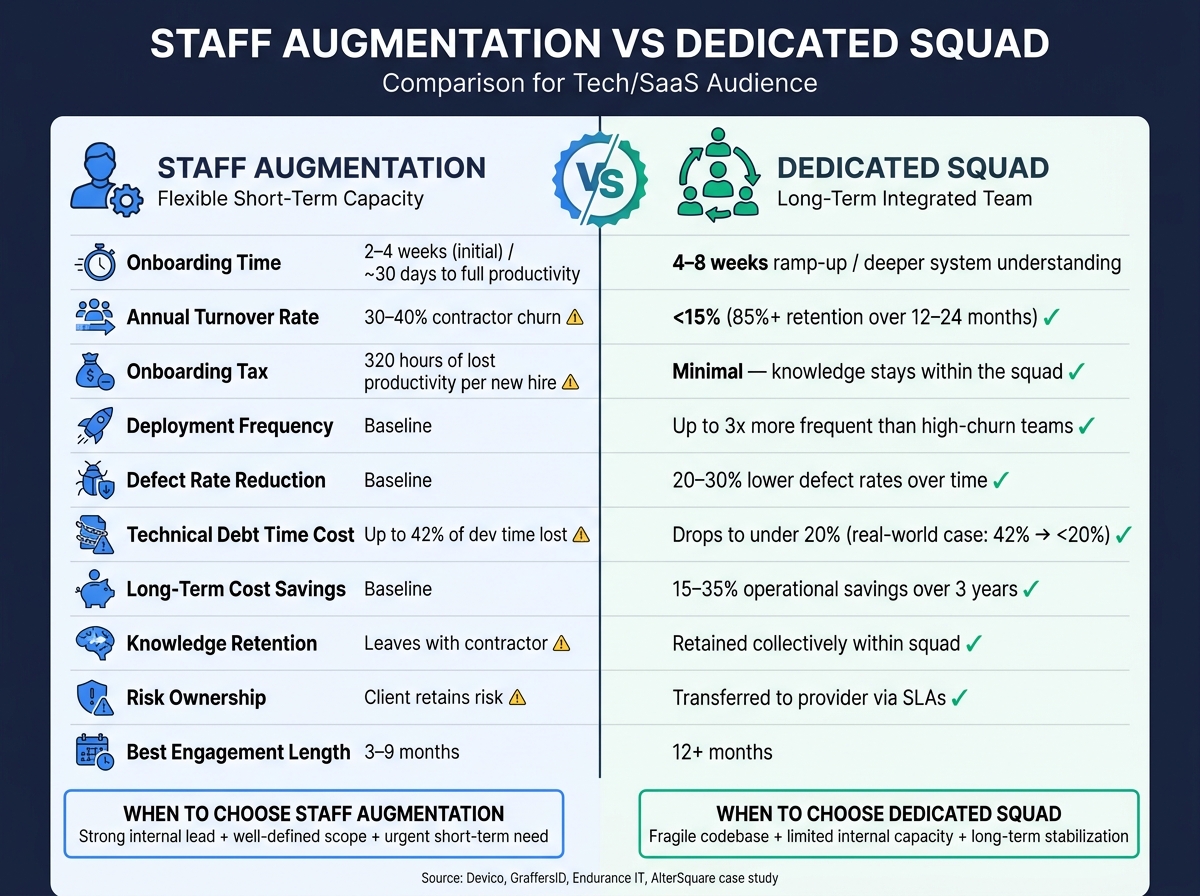
Staff Augmentation vs Dedicated Squad: Risk & Performance Comparison
Comparison by Key Factors
Let’s break down how these two models handle key operational factors. Both aim to address risks in fragile frontends while balancing immediate needs with long-term goals.
| Factor | Staff Augmentation | Dedicated Squad |
|---|---|---|
| Onboarding Time | Shorter (2–4 weeks, though full contextual understanding may take longer) | Longer (4–8 weeks), but leads to a deeper system understanding |
| Knowledge Retention | Relies on the internal team; high risk when contractors leave | Knowledge is shared and retained collectively within the squad |
| Code Ownership | Owned by the client, but risks fragmented standards | Owned by the squad, ensuring consistent patterns |
| Incident Response | Dependent on internal team availability | Squad handles issues directly |
| Alignment with Product Strategy | Requires strong internal direction | Naturally aligned through squad leadership |
With a high annual turnover rate [5], knowledge retention becomes a major structural challenge in staff augmentation. Each contractor rotation brings an "onboarding tax", reducing productivity [5]. Over time, this compounds, especially in fragile frontends.
This table highlights the structural differences between the two models, setting the stage for understanding their impact on system stability and delivery speed.
Effect on Stability and Velocity
Staff augmentation provides quick solutions but struggles with the frequent turnover that weakens system stability. On the other hand, dedicated squads, while slower to get started, gain speed as team cohesion strengthens over time [5]. Team consistency is key – without it, codebases become harder to manage as fixes are undone, patterns diverge, and overall clarity diminishes.
Dedicated squads may take longer to ramp up, but they generate momentum. Teams that stay intact over time can deploy up to 3 times more frequently than those disrupted by constant contractor rotations [5]. They also see defect rates drop by 20–30% as they benefit from accumulated context and consistent workflows [7]. As Joseph D’Souza, Founder of ElectroIQ, explains:
"Augmentation is your tactical quick reaction force; dedicated teams are your strategic force multiplier." [5]
For fragile frontends, that distinction is critical. High deployment speed without stability often leads to more bugs, not fewer.
Effect on Long-Term Maintainability
Beyond stability and speed, long-term maintainability becomes a major factor for fragile frontends. Technical debt is expensive – teams can lose up to 42% of their time, which translates to about $42,000 in annual losses per developer [9]. Poorly maintained frontend architecture can drive refactoring costs up to 1.8 to 2 times higher compared to systems that are well-managed [9].
Staff augmentation helps maintain internal capabilities but comes with a major risk: when contractors leave, their knowledge often leaves with them. This creates gaps in documentation, undocumented workarounds, and decisions no one can explain. Dedicated squads, however, retain institutional knowledge within the team. This continuity results in smoother handoffs, better documentation, and more defensible architectural decisions over time. Companies using dedicated squads report 15–35% operational cost savings over three years, thanks to reduced overhead and improved tooling efficiencies [2][3].
"Companies often underestimate how much the delivery model impacts outcomes. The right choice depends on scale, scope, and control." – Matthew Scott, Vice President, Endurance IT [3]
Conclusion: Picking the Right Model for Your Frontend
Assessing Your Frontend’s Condition
Take a close look at your frontend’s current state before deciding on a model. This means examining your codebase, internal leadership capacity, and the timeline of your project.
If your frontend feels like a "black box" – filled with unclear logic, undocumented workarounds, and inconsistent patterns – it likely needs more than just extra hands. It requires sustained context to avoid further complications [10]. Staff augmentation works well when you have a strong internal lead who can manage contractors daily and when the project scope is clearly defined. However, if your engineering managers are already stretched thin (with 63% reporting severe burnout in 2026 [5]), adding contractors could create more coordination headaches.
The length of engagement matters. Staff augmentation is ideal for short-to-mid-term needs, typically lasting 3–9 months. For longer-term goals, spanning 12 months or more, a dedicated squad can provide the consistency and domain knowledge needed for stability [7][10].
These factors provide the foundation for the decision-making framework below.
A Decision Framework for Founders and CTOs
The following table consolidates the key considerations discussed in this article, offering practical guidance for selecting the best model based on your specific needs.
| Criterion | Points Toward Staff Augmentation | Points Toward Dedicated Squad |
|---|---|---|
| Engagement length | Short-term (3–9 months) | Long-term (12+ months) |
| Internal frontend lead | Available and active | Absent or overloaded |
| Codebase clarity | Documented, stable patterns | Undocumented, fragile, or "black box" |
| Scope stability | Well-defined backlog | Evolving requirements, frequent pivots |
For CTOs with clear project scopes and strong leadership, staff augmentation can deliver quick and efficient results [10]. On the other hand, if your frontend is fragile, your team is stretched thin, and you’re facing a long-term stabilization effort, a dedicated squad is the better choice. This model ensures the vendor handles daily management, maintains essential context, and focuses on outcomes rather than just completing tasks [7].
"If you’re a CTO who knows what you’re building and how you want it built, you don’t want a vendor making architectural decisions behind a closed door. You want developers you can direct, challenge, and course-correct in real time." – GraffersID [10]
Before fully committing to either model, consider starting with a two-sprint pilot. This short trial can highlight potential integration issues, test communication workflows, and help you evaluate whether the chosen model aligns with your team’s approach [11].
FAQs
How do I know if my frontend is “fragile” enough to need a dedicated squad?
A frontend can become fragile when it starts showing problems like outdated code, frequent bugs, sluggish performance, or challenges in adding new features. Some clear warning signs include heavy reliance on outdated tools like jQuery or AngularJS, as well as mounting technical debt that hampers progress. When these issues begin to threaten stability or block modernization efforts, it might be time to bring in a specialized team to address them. However, if the frontend is relatively stable and the technical debt is under control, simply adding extra team members through staff augmentation could be sufficient to keep things on track.
What’s the fastest way to reduce onboarding time in staff augmentation?
The fastest way to cut down onboarding time in staff augmentation is by hiring pre-vetted, experienced professionals. Combine this with clear communication, standardized workflows, and a focus on seamless team integration. These strategies help eliminate bottlenecks, ensuring smoother transitions and quicker productivity gains.
How can I test the model first without committing long-term?
To explore a staff augmentation or dedicated squad model without locking into a long-term commitment, consider starting with a short-term engagement or trial period. For staff augmentation, bring in external developers for a set timeframe – say, 3 to 9 months – to gauge their performance and how well they integrate with your team. Alternatively, partner with vendors that offer flexible contracts or pilot projects. This approach lets you evaluate the team’s quality, communication style, and overall fit before deciding to scale up or make a deeper commitment.







Leave a Reply