
We Build MVPs That Are Designed to Be Deleted. Here’s Why That Saves Our Clients $500K
Taher Pardawala March 6, 2026
Building MVPs (Minimum Viable Products) designed to be replaced can save startups up to $500,000 by avoiding costly rebuilds, reducing technical debt, and speeding up market validation. Traditional MVPs often lead to rigid systems that are expensive to fix when changes are needed. By focusing on modular designs and short-term goals, startups can test market demand faster and scale more efficiently when the time is right.
Key Takeaways:
- Disposable MVPs prioritize speed and flexibility, allowing quick pivots based on user feedback.
- Modular systems mean individual components (e.g., billing, authentication) can be replaced without overhauling the entire product.
- Avoiding emergency rebuilds saves $50,000–$250,000, while faster launches reduce lost revenue by $10,000–$100,000 per month.
- Tools like feature flags and gradual refactoring ensure smooth transitions to scale-ready systems.
This approach ensures startups focus on validating demand first, then scaling based on actual growth, avoiding wasted resources on over-engineered solutions.
How To Plan Your MVP (Minimum Viable Product) in 5 Simple Steps
sbb-itb-51b9a02
What Is Disposable Architecture?
Disposable Architecture is a development approach where Minimum Viable Products (MVPs) are intentionally designed for short-term use. The idea isn’t to craft a system built to last forever but to validate your market quickly. Once you’ve gathered the insights you need, you can replace or upgrade the parts that need to scale. Think of it as building a prototype to gauge market interest. This method embraces technical debt as a calculated choice. Instead of spending months perfecting an architecture for a product that might pivot, the focus is on speed and validation. While the code might be temporary, the lessons and business insights are long-lasting.
At its core, this method relies on a "modular monolith" structure – a single application where distinct business functions, like Billing, Authentication, or Analytics, are housed in separate folders with clear boundaries. This setup avoids the complexity of microservices early on while steering clear of a messy, tangled system. Each module can be replaced independently when scaling becomes necessary.
Strategic planning during the MVP phase can reduce failure rates by 60% and speed up launches by 40% [1]. By leveraging reliable technologies like Node.js, Go, React, and MongoDB – often referred to as the "Golden Path" stack – you ensure that even temporary code adheres to industry standards and remains manageable until it’s replaced.
Core Principles of Disposable Architecture
This system is built around domain-driven design, where code is organized by business function rather than technical layers. For instance:
- The Users module handles all aspects of user management.
- The Billing module manages payment processing.
- The Notifications module oversees messaging.
This separation ensures that changes or replacements in one domain don’t disrupt the others.
Feature flags play a key role, allowing new code to be deployed in a "dark" state. This means the feature is tested with a small subset of users (typically 1–5%) before a full rollout. If something doesn’t work as intended, you can toggle the feature off without resorting to an emergency rollback.
Another critical aspect is structured validation tied to business milestones rather than technical goals. For example, you monitor metrics like CPU usage (with sustained levels above 70–80% signaling potential issues) and database query delays to identify when a module needs attention [1]. Teams that use managed Platform-as-a-Service (PaaS) solutions report over 40% productivity gains and faster MVP launches [1].
These principles create a framework that allows businesses to adapt swiftly to market changes.
Why It’s Built to Be Replaced
The biggest reason startups fail isn’t bad code – it’s creating something the market doesn’t want. Disposable Architecture lets you test your idea without committing to expensive, long-term infrastructure.
Delays can be costly, with each month potentially leading to US$10,000–US$100,000 in lost recurring revenue [2]. By accepting that the initial version of your product will eventually be replaced, you can launch faster – often within 90 days instead of six months. This speed lets you validate demand, generate revenue, and gather user feedback to guide future improvements.
When a module reaches its limits, the Strangler Fig Pattern offers a gradual replacement strategy. A new standalone component is built, traffic is routed to it over time, and the old code is retired. This method avoids sudden, costly rebuilds, which can range from US$50,000 to US$250,000 [2].
While ignoring scalability altogether can increase future costs by 15–25% [2], over-engineering too early wastes resources on features that might never be needed. Disposable Architecture strikes a balance: move fast, validate quickly, and scale strategically based on actual growth rather than hypothetical scenarios.
The Hidden Costs of Standard MVPs
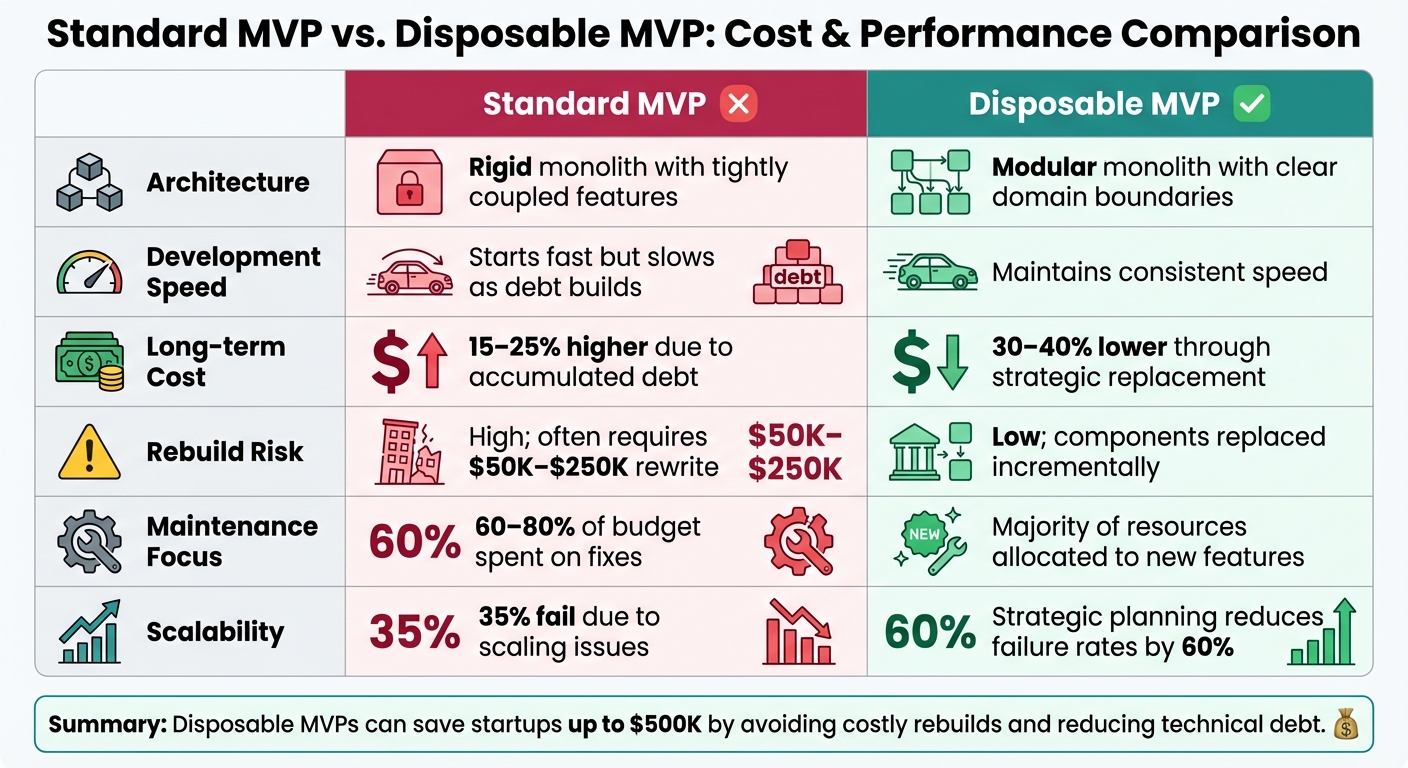
Standard MVP vs Disposable MVP Cost Comparison
Many startups pour resources into an MVP (Minimum Viable Product) only to watch it falter under real-world conditions. This often leads to significant expenses six to twelve months down the line. Understanding these challenges is crucial, as adopting a disposable architecture can provide the flexibility needed to sidestep these costly and operational setbacks.
Standard MVPs tend to rely on rigid architectures where essential elements like authentication, billing, and core features are tightly intertwined. Developers often take shortcuts – hardcoding business rules, creating overly complex models, or skipping critical tests. These decisions pile up technical debt, which compounds over time, much like interest on a credit card. Tasks that should take a few days balloon into weeks as developers struggle to navigate the tangled codebase [2].
"Technical debt isn’t just bad code. It’s the accumulation of quick fixes, skipped documentation, and short-term decisions made to save time, all of which slow you down later." – AlterSquare [3]
The financial consequences are significant. Over 60% of MVPs fail to scale because their technology foundations are insufficient [2]. When systems collapse under pressure, repairs can cost two to three times the original MVP budget, typically ranging between $50,000 and $250,000 [2]. For SaaS startups, delays can be even more damaging, with each month of lost time potentially costing $10,000 to $100,000 in recurring revenue [2]. On top of that, ongoing performance issues can drive customer churn rates up by 20–30% [2].
Standard MVPs vs. Disposable MVPs
These hidden costs make a strong case for the disposable MVP approach. Comparing standard and disposable methods side by side helps clarify their differences:
| Feature | Standard MVP | Disposable MVP |
|---|---|---|
| Architecture | Rigid monolith with tightly coupled features | Modular monolith with clear domain boundaries |
| Development Speed | Starts fast but slows as debt builds | Maintains consistent speed |
| Long-term Cost | 15–25% higher due to accumulated debt [2] | 30–40% lower through strategic replacement [2] |
| Rebuild Risk | High; often requires $50K–$250K rewrite [2] | Low; components replaced incrementally |
| Maintenance Focus | 60–80% of budget spent on fixes [3] | Majority of resources allocated to new features |
| Scalability | 35% fail due to scaling issues [1] | Strategic planning reduces failure rates by 60% [1] |
This comparison underscores why disposable MVPs are a smarter choice for startups. Standard MVPs often trap teams in a vicious cycle of maintenance, where only 30–40% of development time goes toward building new features, with the rest consumed by debugging and patching [3]. In contrast, disposable architecture embraces the idea that early-stage code is temporary. By designing it to be modular and organized, startups can replace components incrementally when needed. This approach shifts the focus from short-term cost savings to long-term adaptability and growth, making disposable MVPs a leaner and more effective solution.
How Disposable MVPs Save Startups $500K
The impressive $500,000 in savings comes from avoiding costly rebuilds, reducing technical debt, preventing market delays, and cutting down maintenance expenses. By leveraging disposable architecture, startups can validate ideas quickly without committing to long-term financial risks.
Cost Savings Breakdown
Smart early decisions make disposable MVPs a cost-effective learning tool over time.
- Avoided rebuilds: Modular architecture allows startups to replace components incrementally, saving between $50,000 and $250,000 as milestones are achieved [2].
- Deferred scaling costs: Disposable MVPs delay investments in scalability features like API versioning and service isolation until they are justified by revenue milestones. This saves $8,000 to $12,000 upfront compared to standard MVPs [2].
- Reduced technical debt: Traditional MVPs often face a 15–25% cost increase due to shortcuts, hardcoded rules, and lack of documentation. Disposable MVPs avoid these pitfalls, translating to $10,000 to $50,000+ in savings as the product evolves [2].
- Faster market entry: Launching 20–40% faster than typical in-house development projects, disposable MVPs help startups avoid the 27% budget overruns common in traditional projects [4]. For SaaS companies, every month of delay can mean $10,000 to $100,000 in lost recurring revenue [2]. Even a three-month advantage can bring in $30,000 to $300,000 during the critical validation phase.
Here’s a snapshot of how these savings add up:
| Cost Component | Standard MVP | Disposable MVP | Savings |
|---|---|---|---|
| Initial Development | $15,000–$35,000 | $18,000–$35,000 | Comparable initial costs |
| Emergency Rebuild | $50,000–$250,000 | $0 | $50,000–$250,000 |
| Tech Debt Penalties | 15–25% cost increase | 0% | $10,000–$50,000+ |
| Lost Revenue (3-month delay) | $30,000–$300,000 | $0 | $30,000–$300,000 |
| Total Impact | $95,000–$635,000 | $18,000–$35,000 | ~$500,000 |
These savings aren’t just theoretical – they’re backed by real-world success stories.
Case Examples
Disposable MVPs have consistently proven their worth in validating market demand without the heavy financial burden of a full-scale build.
Take Dropbox, for example. Instead of creating a complex file synchronization backend, founder Drew Houston launched a simple 3‐minute explainer video. This disposable MVP skyrocketed their beta waiting list from 5,000 to 75,000 overnight, validating demand at a fraction of the cost [6][7].
Buffer founder Joel Gascoigne went even leaner. He built a two-page landing page MVP: one page explained the product, and the other showcased pricing. By tracking clicks on the "Plans and Pricing" button – before the product even existed – he validated customer interest and willingness to pay, avoiding the expense of building a full social media scheduling tool [5][7].
Even Zappos started small. Founder Nick Swinmurn tested his e-commerce concept by photographing shoes at a local mall and posting them online. When customers placed orders, he purchased the shoes at full price and shipped them manually. This "Concierge MVP" proved people were willing to buy shoes online, all without the need for massive investments in inventory or warehousing [5][6].
These examples show that spending $15,000 to $50,000 on validation is far smarter than risking $300,000+ on a product the market might not even want [8].
"Spending $50k on an MVP that your audience loves is far smarter than spending $300k on a full product to discover people don’t want it." – Cabot Technology Solutions [8]
Moving from Disposable to Scale-Ready Systems
Once market demand is validated, the next step is transitioning to a scalable system – without tearing everything down. AlterSquare uses a milestone-driven approach to gradually replace problematic components, ensuring your product stays live and continues generating revenue throughout the process.
This transition relies on managed refactoring, which begins when specific revenue or performance benchmarks are met. Instead of halting operations for a full rebuild, the Strangler Fig Pattern is applied to phase out legacy modules and replace them with high-performance alternatives [1]. This method ensures uninterrupted service while upgrading outdated systems. With tools like the Traffic Light Roadmap, this approach allows for precise, step-by-step refactoring and monitoring.
Milestone-Based Refactoring
Refactoring builds on the flexibility of your disposable MVP, allowing it to grow as market traction becomes evident. The shift to a scale-ready system aligns with your business milestones, not a rigid timeline. AlterSquare initiates refactoring when performance indicators – like CPU usage exceeding 70–80% [1], API response times above 500 ms [9], or declining user retention [9] – signal the need for action. At this point, 20–30% of development resources are allocated to strengthening the technical foundation while continuing to roll out new features.
Think of it as precision work. For instance, an e-commerce MVP handling 100,000 products transitioned to microservices over five months. This allowed the team to integrate new payment methods in just days instead of weeks, boosting overall development speed by 300% [1].
The process also employs feature flags, which allow new scalable code to be deployed "dark" (inactive) and tested in staging environments. From there, it’s gradually rolled out to a small percentage of users (1–5%) in a canary release [1]. If metrics remain stable, exposure is increased in stages – 1%, 5%, 10%, 25%, 50%, and finally 100%. Any issues? The system can instantly roll back to the stable version, ensuring customers aren’t affected.
Once these refactoring milestones are identified, a structured roadmap guides ongoing system improvements.
Traffic Light Roadmap for Scaling
To keep the transition smooth, AlterSquare uses a Traffic Light Roadmap. This system health tracker categorizes each component as Critical (red), Managed (yellow), or Scale-Ready (green). It monitors both infrastructure metrics (like CPU, memory, and query delays) and application metrics (such as latency and error rates) to spot bottlenecks early [1]. The roadmap focuses on high-impact user flows – login, onboarding, checkout, and search – that directly influence revenue.
For example, if a database query delay exceeds 500 ms, the module is flagged as red. Targeted fixes, like optimizing N+1 queries or adding caching layers, are then applied. The aim isn’t perfection but maintaining a system that’s healthy enough to scale effectively.
This approach not only avoids costly system overhauls but also delivers a 3–10× ROI. By planning strategically during this phase, failure rates can drop by 60%, and product launches can happen 40% faster [1].
Conclusion
Disposable Architecture isn’t about quick fixes or temporary solutions. It’s a strategic approach that grows alongside your business. By focusing on speed and validation rather than over-engineering, startups can sidestep one of the biggest pitfalls – misjudging market needs, which causes 42% of startups to fail [1][10]. Instead of dealing with costly system overhauls when growth challenges arise, this method provides a modular framework that evolves as your business hits key milestones.
This approach can reduce development costs by as much as 50%, while also saving money in the long run [1]. By validating demand early, your MVP grows in step with your business. And when it’s time to scale, the modular design allows you to fix or upgrade only what’s necessary – keeping operations running smoothly without disrupting revenue.
"We build it right the first time. Every line of code is architected for scale, eliminating costly rewrites at growth milestones." – AlterSquare [1]
This method doesn’t just help you test the market; it ensures your product is ready to scale when the time comes. AlterSquare’s approach mirrors how startups naturally grow: validate first, scale when the data supports it, and refactor based on revenue – not arbitrary deadlines. Tools like the Traffic Light Roadmap help avoid surprises with technical debt, while the Strangler Fig Pattern ensures your product stays live during transitions. This framework gives you the flexibility to steer your product’s growth exactly how you want.
When it’s time to scale, you’re building on a foundation that’s already designed to support your success.
FAQs
When should I use a disposable MVP?
When your main goal is to quickly test a business idea, a disposable MVP can be the perfect solution. This approach works well for early-stage startups that need to prioritize speed and cost-effectiveness to assess market fit and collect feedback. It’s especially useful in situations where frequent pivots are likely, as it helps limit technical debt and avoids expensive rebuilds – potentially saving as much as $500,000 in the process.
How do I keep a “throwaway” MVP from becoming a mess?
To keep a "throwaway" MVP focused and efficient, zero in on its core functionality – the absolute essentials that solve the main problem. Resist the temptation to pile on extra features that can complicate things. Opt for a modular design so you can easily add or adjust components as the product grows. Make it a habit to collect user feedback regularly; this will help you identify what’s truly important and address issues step by step instead of chasing perfection right away. This approach keeps things simple, minimizes tech debt, and ensures the MVP can evolve smoothly over time.
What metrics tell me it’s time to refactor or replace a module?
Key indicators to watch out for are performance bottlenecks, growing technical debt, and architectural mismatches. For instance, if a specific module is slowing down performance, causing database problems, or restricting scalability, it might be time to consider refactoring or replacing it. Similarly, if outdated architecture is leading to rising costs, delays, or frequent system failures, it’s a clear sign that small fixes won’t cut it anymore – a more thorough update is likely needed.








Leave a Reply