
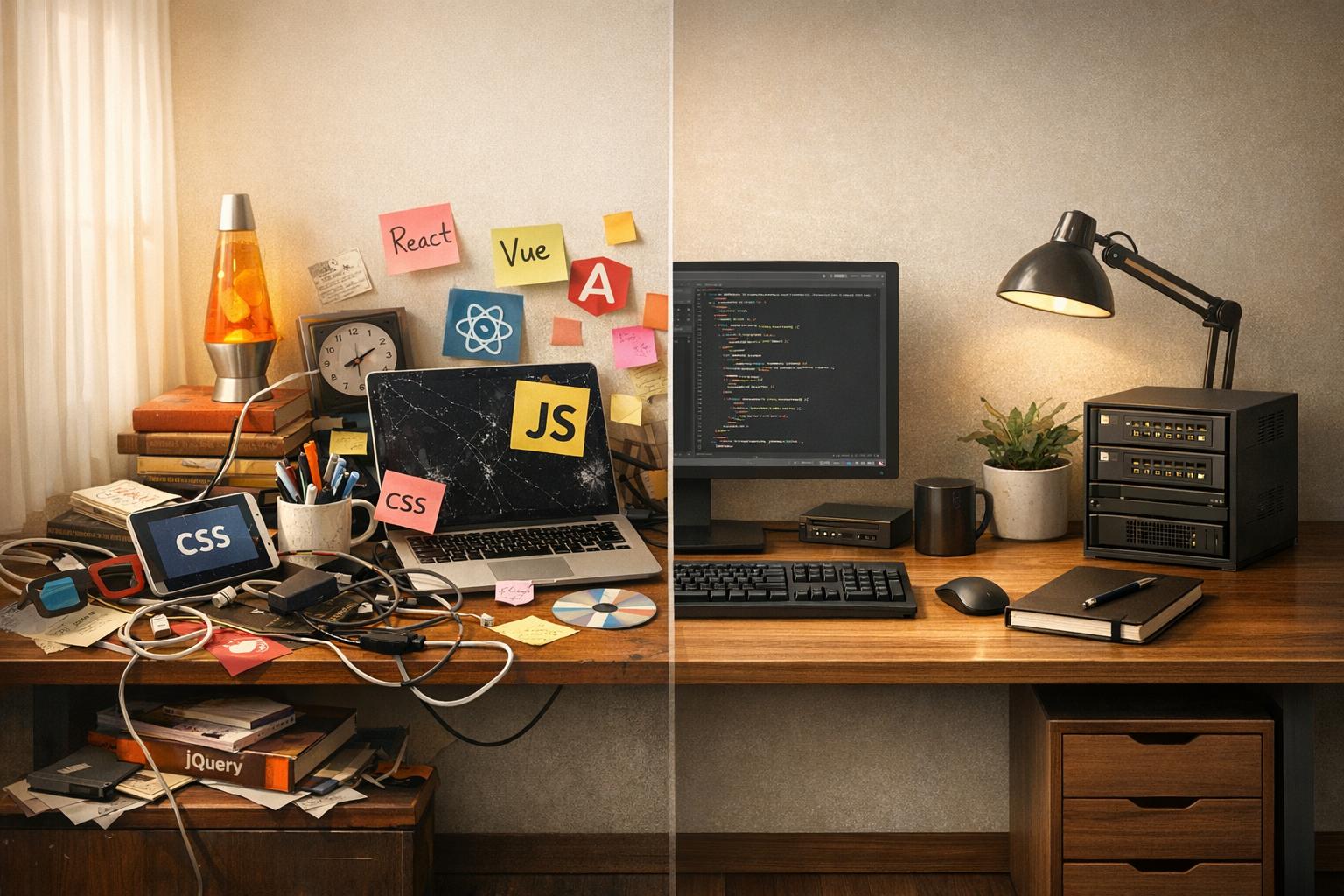
Frontend technologies evolve much faster than backend systems. Frameworks like React and Angular often require updates or replacements every 3–5 years. Backend tools like Ruby on Rails or Django, however, remain stable for over a decade. This difference stems from frontend systems needing to work across various devices and browsers, while backend systems operate in controlled environments. For startups, this faster pace of frontend change can lead to costly rewrites, higher maintenance costs, and challenges in hiring skilled developers.
Key points:
- Frontend evolves faster: Frameworks and libraries change frequently, driven by user expectations, browser updates, and design trends.
- Backend is more stable: Backend technologies emphasize reliability and operate in predictable server environments.
- Startups face risks: Outdated frontend tech can harm user experience, increase expenses, and limit scalability.
- Solutions: Use modular designs, choose stable frameworks, and plan for gradual updates instead of full rewrites.
Frontend decisions can impact a product’s longevity and costs. Building systems that allow for future updates without complete overhauls is key to managing this challenge.
The Problem: Frontend Technologies Become Outdated Quickly
Frontend technologies age at a pace that creates significant challenges for startups, including security risks, higher maintenance costs, and difficulty attracting skilled developers. Companies stuck with outdated tech stacks often face an average 35% undervaluation during technical audits and overpay by approximately 21% for development teams maintaining legacy frontend systems [11]. These factors can directly hinder your ability to secure funding, hire top talent, and remain competitive. The rapid evolution of tools and design trends only adds to the complexity of maintaining frontend systems.
Constant Framework and Library Changes
Frontend frameworks evolve so quickly that decisions made just a few years ago can become obsolete. For instance, on February 14, 2025, the React team officially deprecated Create React App (CRA), a once-standard starter kit, forcing many teams to rethink their entire build process and project structure [5]. Tools like Webpack, Babel, and TypeScript frequently require updates to stay compatible with newer Node.js versions or operating systems [10]. This relentless cycle – often called the "frontend treadmill" – means engineering resources are constantly diverted from building new features to just keeping up with changes. As Alvis Ng, a Technical Lead, explains, this cycle can significantly slow down innovation [7].
Changing User Experience and Design Standards
User expectations evolve at a breakneck speed. What felt cutting-edge just a couple of years ago – like simple client-side rendering with loading spinners – now feels outdated compared to modern approaches like streaming interfaces and partial hydration patterns [6]. This rapid shift forces startups to choose between sticking with outdated performance or investing heavily in refactoring.
By 2025–2026, most major frameworks are adopting new patterns like Signals for fine-grained reactivity and Server Components, which blur the lines between frontend and backend [6][9]. Applications built on older paradigms often feel slower and less responsive, leaving teams with a tough choice: accept a dated user experience or pour significant engineering effort into modernization.
For example, when Angular 19 introduced Signals and Vue 3.5 refined its Composition API, these frameworks fundamentally changed how state management works [6]. Teams relying on older approaches now face the challenge of either sticking with legacy designs or committing to large-scale refactoring to keep up.
Browser and Device Compatibility Issues
Unlike backend systems, which operate in controlled environments, frontend code must function seamlessly across an ever-changing landscape of browsers and mobile devices [11]. When frameworks stop receiving updates, applications can gradually lose compatibility with newer browser versions – leading to broken features and layout issues on modern devices [11]. This constant environmental volatility makes frontend systems far less stable over time compared to backend systems, which rarely face such unpredictable shifts.
Without regular updates, frontend applications risk delivering a degraded experience, frustrating users and potentially driving them to competitors. This makes keeping up with frontend advancements not just a technical necessity but also a business imperative.
sbb-itb-51b9a02
Why Backend Decisions Last Longer
Backend systems tend to evolve at a slower pace compared to frontend technologies, and this difference shapes the careers of backend engineers. While frontend developers often face the need to keep up with the latest frameworks, backend engineers can build enduring careers working with established tools like Ruby on Rails or Django. This stability can be traced to three main factors: the deeply understood nature of backend challenges, the controlled environments in which backend systems operate, and the high stakes associated with making changes.
Slower Evolution of Backend Systems
Unlike the fast-paced world of frontend development, backend technologies focus on reliability and maintaining data integrity rather than chasing the latest trends. The core challenges of backend development – like authentication, data storage, and distributed computing – are well-defined and have been for decades. Established methods, such as connection pooling and load balancing, minimize the need for constant overhauls [13]. As Kevin Ball, President of ZenDev, explains:
"One can make a good living as an API developer using Ruby on Rails without spending half of your work life racing to keep up" [3].
This gradual evolution means backend frameworks typically undergo steady improvements rather than disruptive rewrites. While frontend frameworks may become outdated within five years, backend systems are often expected to remain functional and profitable far longer – sometimes exceeding that five-year mark without major structural changes [1][2]. The ecosystem’s maturity has also led to the automation and standardization of many tasks, reducing the need for frequent tool-switching [3].
Predictable Server Environments
Backend systems benefit from operating in controlled server or cloud environments, which reduces the unpredictability that frontend developers often face [3]. These standardized environments ensure that backend architectures remain stable over time. With version-controlled systems in place, backend engineers can rely on their decisions holding up for years. Additionally, as more complexity shifts to the frontend, backend tools have become increasingly refined, automating processes that once required manual oversight [3].
Higher Risk of Backend Changes
Making changes to backend systems involves a higher level of risk compared to frontend updates. A poorly executed backend change can lead to severe consequences, such as data loss, widespread downtime, or security vulnerabilities. These potential outcomes far outweigh the impact of a slow-loading page or a minor visual issue on the frontend. This risk naturally encourages more cautious and deliberate decision-making, reinforcing the backend’s slower rate of change [13][2].
On top of that, backend systems often serve multiple frontend interfaces – think web apps, mobile platforms, and IoT devices. Any modification to a shared backend requires input and validation across teams to ensure compatibility. This collaborative process, while necessary, further slows the pace of backend evolution [12]. The emphasis on stability and coordination helps prevent rushed decisions that could jeopardize the entire system’s functionality.
How Frontend Decisions Affect Startups
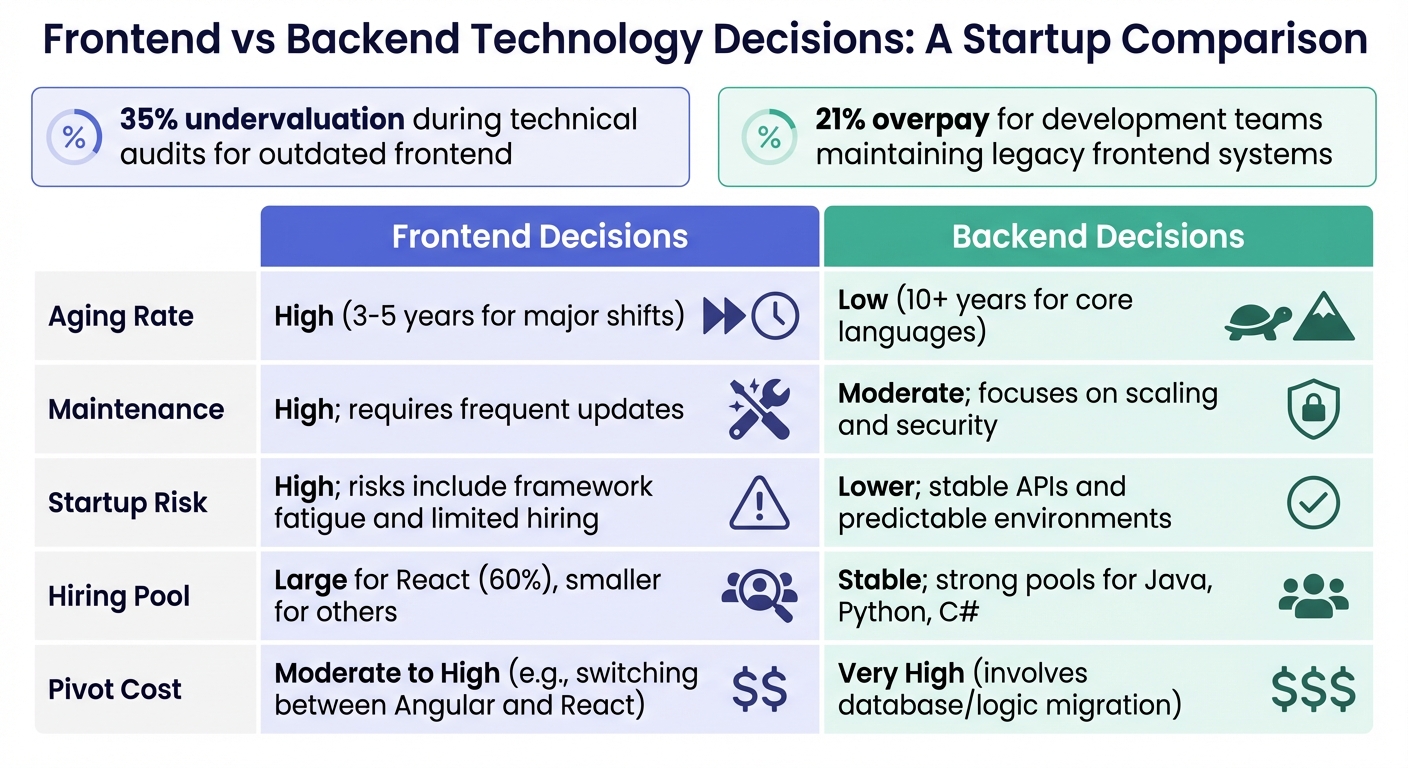
Frontend vs Backend Technology Aging: Maintenance Costs and Risks Comparison
For startups, choosing the right frontend technology is more than just a technical decision – it’s a financial one with long-term consequences. These decisions directly influence a startup’s ability to sustain its product over time. Most startups aim to launch within a year and stay profitable for at least five years. However, frontend frameworks often become outdated within that same timeframe, forcing startups into tough trade-offs [1][2].
Comparing Aging Rates and Maintenance Costs
The financial impact of frontend versus backend decisions becomes especially clear when factoring in technical debt. Think of technical debt like a high-interest credit card – it can quickly drain a startup’s engineering resources if not managed properly. Emily Dresner, an Engineering Manager, puts it bluntly:
"Tech debt is the team killer. Think of features vs. debt like the team’s credit card. Paying off your credit card every month is fine. However, a high-interest rate will bankrupt you if you don’t pay it down" [14].
Frontend and backend systems age at different rates and carry distinct maintenance burdens. Here’s a closer look:
| Feature | Frontend Decisions | Backend Decisions |
|---|---|---|
| Aging Rate | High (3–5 years for major shifts) [4][1] | Low (10+ years for core languages) [15] |
| Maintenance | High; requires frequent updates [5] | Moderate; focuses on scaling and security [15] |
| Startup Risk | High; risks include framework fatigue and limited hiring [15] | Lower; stable APIs and predictable environments [15] |
| Hiring Pool | Large for React (60%), smaller for others [6] | Stable; strong pools for Java, Python, C# [15] |
| Pivot Cost | Moderate to High (e.g., switching between Angular and React) [6] | Very High (involves database/logic migration) [14] |
Hiring trends also weigh heavily on frontend decisions. React dominates the landscape, with around 60–65% of frontend engineers listing it as their primary skill [6]. On the flip side, choosing a less popular or declining framework can shrink the talent pool, driving up salaries and making recruitment harder [17]. For example, when Create React App was officially deprecated on February 14, 2025 [5], many startups were forced to migrate to alternatives like Next.js or Vite, leading to unplanned expenses.
Case Studies: Frontend Rewrites vs. Backend Stability
The challenges of frontend decisions become even clearer when looking at real-world examples. Frontend rewrites are common, while backend systems often remain stable for years. Joel Spolsky, co-founder of Stack Overflow, famously cautioned:
"the single worst strategic mistake that any software company can make" [16].
Startups often face this dilemma with frontend systems. When a framework loses popularity or compatibility issues arise, years of bug fixes and edge case handling – like browser-specific quirks or low-memory optimizations – are tossed out during a full rewrite [16][7]. This contrasts with backend systems, which, built on established languages, can stay operational for decades.
An outdated frontend can create what some developers call a "death spiral." Engineers may abandon struggling products, leaving startups in a precarious position [14]. While backend failures can lead to downtime or data loss, an outdated frontend typically results in an immediate drop in user engagement. This forces startups to act quickly, often requiring frequent and costly updates to stay competitive.
Solutions: Making Frontend Development Last Longer
To address the challenge of rapid frontend obsolescence, startups need strategies that strike a balance between staying current and ensuring stability. These approaches can help extend the lifespan of frontend decisions while keeping room for future adjustments.
Build Modular and Replaceable Systems
One way to manage the constant evolution of frontend technologies is to design systems that can adapt over time. Feature-Sliced Design (FSD) is a method that structures code into distinct layers – app, pages, widgets, features, entities, and shared – with strict rules governing how they interact [18]. By ensuring that higher layers depend on lower ones, but not the other way around, this approach minimizes the risk of tangled "spaghetti code" that often leads to expensive rewrites.
Taking modularity a step further, a three-layered architecture divides your system into a UI Layer (the visual interface), an Abstraction Layer (domain-specific API), and a Core Layer (third-party libraries) [8]. This setup makes it easier to update or replace components like state management libraries or mapping SDKs without disrupting the rest of the system. Such modular designs form a strong foundation for maintaining frontend longevity.
Choose Stable, Well-Maintained Frameworks
The lifespan of a framework depends on three critical factors: backward compatibility, the ability to adapt to new standards, and a proven track record over several years [2]. For instance, Angular is often preferred for large, multi-team projects due to its solid governance, while Vue is popular for its ease of use in design-heavy SaaS applications [6].
It’s wise to steer clear of frameworks that have a history of releasing non–backward compatible updates ("bombing") or losing momentum due to stalled innovation and dwindling community support ("fizzling") [2]. As Brian Moschel, CEO of Bitovi, puts it:
"Framework longevity is a critical ingredient in project success" [2].
Planning for a five-year timeframe is a good rule of thumb, as most successful applications tend to last at least that long [2]. A reliable framework makes gradual updates manageable, reducing the need for disruptive overhauls.
Use Phased Delivery and Regular Tech Reviews
Gradual migrations are almost always a better choice than large-scale rewrites. The Strangler-Fig pattern, for example, allows teams to migrate one feature or route at a time, enabling old and new code to coexist through approaches like microfrontends or module federation [6]. Feature flags can help manage this transition by controlling access to newly migrated components, making it easy to roll back if problems arise. This approach avoids long periods of downtime where teams might struggle to adapt to shifting requirements [19].
Regular tech reviews are essential to catch "code decay" – when your code no longer aligns with updated HTML standards or evolving business needs – before it becomes a major issue [20]. Tracking migration progress with visual tools and assigning clear ownership ensures momentum doesn’t stall [19].
Use AI for Fast Prototyping and Testing
AI tools are becoming valuable for quickly evaluating architectural options and testing new technologies in isolated environments before full-scale implementation [4]. These tools can help teams experiment with emerging frontend trends without committing to risky changes. As Rohit V., a software engineer, explains:
"The developers who thrive through these transitions aren’t the ones who master every new framework fastest. They’re the ones who understand the underlying patterns each framework is trying to address" [4].
Conclusion: What Startups Should Remember
Frontend technologies are in a constant state of flux, evolving far more rapidly than backend systems. This rapid pace of change stems from frequent updates to frameworks, shifting design trends, and new browser capabilities. Unlike backend systems, which benefit from stable server environments and slower update cycles, frontend code must continually adjust to new devices, user expectations, and framework updates. For startups, this presents a unique challenge: keeping up with these changes without sacrificing scalability.
The solution lies in prioritizing structural resilience over chasing the latest trends. Instead of jumping on every new framework, startups should focus on building modular systems that allow for component-level updates. A three-layered architecture – where the user interface is separated from core logic – can significantly extend the life of your frontend investments. Choosing frameworks with a track record of stability and opting for gradual migrations instead of complete rewrites can also make a big difference. As Marco Rogers wisely points out:
"Whatever framework you choose will be obsolete in 5 years… Replacing it with a shiny new tool is a trap" [1].
By adopting a modular design, you can reduce technical debt and avoid the pitfalls of tightly coupled systems. This approach allows specific components to be updated or replaced without disrupting the entire application. Not only does this save on maintenance costs, but it also creates a solid foundation for scaling your startup. Considering that successful applications often need to remain viable for at least five years [2], your frontend decisions should align with that timeline.
Startups should focus on mastering web fundamentals rather than getting bogged down in framework-specific details. Invest in understanding enduring patterns and regularly review your tech stack to identify and address potential issues before they escalate. The startups that succeed aren’t the ones that adopt new frameworks the fastest – they’re the ones that build systems designed to last. By treating frameworks as interchangeable tools and emphasizing modular, future-ready designs, you can minimize technical debt and concentrate on delivering meaningful value to your users.
FAQs
Why do frontend technologies advance more quickly than backend systems?
Frontend technologies are constantly evolving, driven by the need to meet shifting user expectations and the fast-paced innovation in the web ecosystem. Changes in design trends, performance demands, and interactivity push frameworks, libraries, and tools to update frequently, often leaving older solutions feeling outdated in just a few years.
On the other hand, backend systems prioritize stability and long-term dependability. Updates in this area tend to focus on improving scalability and operational efficiency rather than responding to external trends. As a result, backend technologies evolve at a steadier, more gradual pace.
Why do frontend technologies change so quickly, and how can startups keep up?
Frontend technologies are constantly changing, driven by evolving user expectations and the steady flow of new tools and frameworks. For startups, navigating this dynamic landscape means focusing on the core building blocks of the web – HTML, CSS, and JavaScript. These fundamentals are timeless and provide a solid foundation. When selecting frameworks, opt for those with active communities and well-documented upgrade paths. Instead of chasing every shiny new trend, prioritize mastering universal principles like routing, data management, and caching – concepts that remain relevant no matter which tools you use.
To keep your development process flexible and future-ready, aim for a lightweight, modular UI architecture. Incorporate design tokens, utility-first CSS solutions like Tailwind, and a straightforward component library that can grow with your needs. Make time for regular refactoring and incremental updates to prevent your codebase from becoming outdated. Keeping an eye on emerging trends also helps you plan migrations before your stack falls behind.
It’s also essential to integrate a decision-making framework into your development roadmap. This framework should weigh technical risks, team expertise, and long-term scalability. Focus on hiring developers who are not only skilled in your chosen stack but also proficient in core web standards. Avoid getting swept up in buzzwords and trends. By staying disciplined and flexible, startups can minimize technical debt while taking advantage of the latest advancements to create excellent user experiences.
How can you make frontend decisions last longer?
To make your frontend decisions last longer, start by selecting frameworks or libraries that have a track record of stability and support. Seek out tools backed by an active developer community, solid corporate sponsorship, and thorough documentation. Features that are backward-compatible are also a big plus. Consider using a modular architecture to divide your UI into reusable components – this way, you can upgrade or swap out parts without reworking the entire application.
Instead of chasing every new trend, focus on becoming proficient with your current tools. A deep understanding of your stack allows you to navigate its limitations, implement incremental updates, and steer clear of expensive rewrites. Rely on standard web APIs and isolate framework-specific code to reduce your dependence on any single tool.
And remember, change is unavoidable. Concentrate on enduring principles like state management, accessibility, and performance rather than the nuances of specific framework syntax. Keep your dependencies up to date, watch for deprecated features, and view refactoring as an ongoing effort. This forward-thinking approach helps you manage technical debt and ensures your codebase stays flexible over time.







Leave a Reply