

Frontend teams often create technical debt without noticing it, leading to slower development, bugs, and scalability issues. Here’s a quick breakdown of how this happens and what you can do to manage it:
- Rushed Decisions: Tight deadlines lead to skipped testing, duplicated components, and shortcuts like using loose
anytypes in TypeScript. - Poor Architecture: Overloaded components, excessive global state, and outdated frameworks make future updates difficult.
- Code Inconsistencies: Missing coding standards and duplicated logic create messy, unmanageable codebases.
- Dependency Neglect: Delayed updates to libraries increase security risks and maintenance overhead.
- Design Misalignment: Gaps between design and development result in redundant code and inconsistent user interfaces.
Key Strategies to Tackle Technical Debt:
- Set Code Standards: Use tools like ESLint and Prettier to automate code quality checks.
- Test Components in Isolation: Tools like Storybook help identify and fix issues early.
- Schedule Refactoring: Dedicate 10–20% of sprints to cleaning up code.
- Align Design and Development: Use shared design systems to reduce mismatched implementations.
- Manage Dependencies: Regularly update libraries to avoid version lock and security risks.
By addressing technical debt early and consistently, teams can maintain development speed while keeping their codebase clean and scalable.
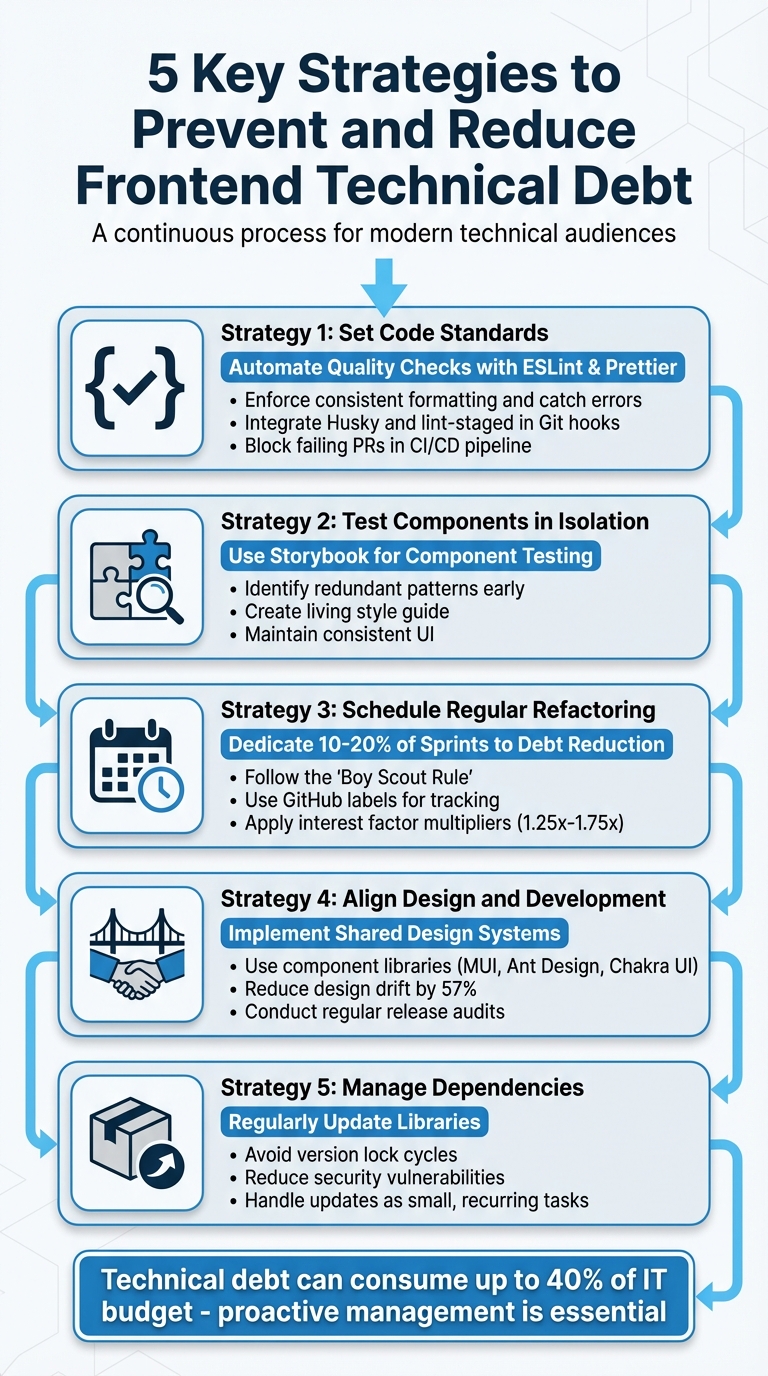
5 Key Strategies to Prevent and Reduce Frontend Technical Debt
How Frontend Teams Accumulate Technical Debt
Poor Architecture Choices During Early Development
Hasty architectural decisions during the early stages of development can lead to a fragile foundation that slows future progress. A common misstep is creating "fat" components that combine business logic, API calls, and presentation code in one place. These bulky components become difficult to test, reuse, or maintain across the application [5].
For instance, in September 2021, Miro addressed bloated Angular components as part of their migration to React. Software Engineer Gonzalo streamlined the process by separating business logic from presentation using custom React hooks and pulling reusable components into a design system. This approach sped up accessibility improvements and overall development [5].
Another frequent issue is the overuse of global state early on, such as relying on a centralized globals.js file. This practice creates a fragile structure that can destabilize the entire application [2]. Similarly, bypassing middleware teams to meet tight deadlines often results in quick fixes that rarely get replaced with scalable backend solutions [1].
Framework selection also has lasting consequences. Choosing frameworks without backward compatibility – like the shift from AngularJS to Angular 2 – can force teams into costly rewrites. Web engineer Shaun Stone highlighted this challenge:
"Since Angular 2 is not backward compatible, all existing apps built in Angular 1.x are required to be migrated… That’s an expensive statement to make for a lot of companies" [4].
Skipping test-driven development during initial builds is another risky move. It reduces code coverage, making future changes more prone to errors and harder to implement safely [3][5].
Codebase Inconsistencies and Missing Standards
Beyond architectural missteps, a lack of consistent coding standards can lead to escalating maintenance headaches. When coding practices aren’t enforced, small inconsistencies snowball into major issues [2].
For example, a lack of clear naming conventions for variables and files can make a codebase unreadable, forcing new developers to spend hours deciphering it [3]. Violating DRY (Don’t Repeat Yourself) principles – by duplicating components or copy-pasting logic from sources like StackOverflow – adds unnecessary code bloat and creates inconsistent behavior across the application [1].
Tools like ESLint and Prettier can help by automatically enforcing style guides and flagging problematic code [1][8]. Without these tools, teams are more likely to encounter security vulnerabilities, such as missing encryption or poorly implemented CAPTCHAs [3].
Framework Lock-In and Outdated Dependencies
Dependency management is another area where technical debt can pile up. Delaying updates to dependencies not only increases maintenance overhead but also introduces security risks and misses out on performance improvements in newer versions [9][10]. When teams put off updates, they risk entering a "version lock" cycle, where upgrading one package requires updating a cascade of dependent packages [9]. App developer Nimra Ejaz explains:
"Delayed dependency upgrades can cost you a lot more effort in the future if you handle them as small, recurring tasks. For example, direct jumping from version 1 to version 4 can drag you into huge overhead maintenance" [9].
Outdated libraries also pose security risks. A well-known example is the 2018 EventStream incident, where a malicious dependency called "flatmap-stream" was introduced, impacting applications like the BitPay wallet [10]. Additionally, modern frontend projects often suffer from "dependicitis." For instance, a basic create-react-app setup can pull in around 1,500 packages just to render a "Hello World" page, each one representing a potential vulnerability [11].
Design-Development Misalignment
Misalignment between design and development teams is another major contributor to frontend technical debt. When communication breaks down, developers often resort to quick fixes that result in messy, unmaintainable code. This happens when design files don’t align with technical feasibility or bypass established component libraries, forcing developers to create one-off solutions [6].
In July 2022, Delivery Hero’s talabat brand faced this problem. DesignOps Director Amber Jabeen conducted an audit and found that every project release accumulated frontend debt due to "design drift" – the gap between original designs and the final implementation. By using their "Marshmallow" design system, the team reduced time-to-market by 57% while avoiding new technical debt [6].
When design and development aren’t in sync, developers may write custom CSS overrides, create duplicate components with slight variations, or hardcode values that should be centrally managed. Over time, these shortcuts add up, making the codebase harder to maintain and scale [6].
The Impact of Technical Debt on Frontend Teams
Slower Development Cycles and More Bugs
Technical debt grows like interest on a loan, making it harder to add new features over time. Martin Fowler, a well-known software developer, explains it best:
"The extra effort that it takes to add new features is the interest paid on the debt" [7].
For example, a feature that should take four days might stretch to six because of a poorly organized module [7]. As technical debt accumulates, estimating timelines becomes a guessing game, leading to missed deadlines and unpredictable release schedules [1].
Messy code often invites more shortcuts. Imagine encountering a React component with 13 props – it screams neglect. This signals to developers that quality isn’t a priority, encouraging more compromises. Over time, the codebase becomes a tangled mess, nearly impossible to maintain [2]. For frontend teams, this issue is particularly visible: bugs show up directly in the user interface, impacting customers immediately [1]. A striking statistic reveals that six out of ten CIOs have reported growing technical debt over time [1]. These delays don’t just disrupt timelines – they also make scaling the product a nightmare.
Difficulty Scaling the Product
When feature enhancements are delayed, MVP (minimum viable product) solutions often crumble under real-world conditions. Technical debt can consume up to 40% of a company’s IT budget [13]. A glaring example of this is the October 2013 launch of HealthCare.gov. Rushed timelines led to crashes, security problems, and incomplete functionality. Fixing these issues after launch ended up costing far more than if the system had been built correctly from the start [12].
At scale, even minor bugs can snowball. A glitch affecting just 1% of users might impact millions. On top of that, messy code and poor documentation slow down onboarding for new engineers, making it harder to grow the team [13]. Outdated systems also drive up operational costs, as fragile architectures require more resources to stay functional.
Team Morale and Burnout
The effects of technical debt go beyond timelines and scalability – it also wears down developer morale. When engineers spend more time fixing old problems than building new features, frustration sets in. Hiren Dhaduk, CTO at Simform, puts it bluntly:
"If a developer has to spend a larger chunk of time on paying off technical debt rather than adding value to the software, their morale will take a hit" [1].
Unmaintainable code becomes a daily battle, forcing developers to wrestle with undocumented hacks and outdated logic. This creates a toxic cycle where nothing feels solvable, and no one seems to care [2]. Such an environment often pushes talented developers to leave for roles with cleaner, more modern tech stacks. The result? Higher turnover and a harder time attracting top talent.
Strategies to Prevent and Reduce Frontend Technical Debt
Adopt Code Standards with ESLint and Prettier
One effective way to tackle technical debt is by automating code quality checks. Tools like Prettier ensure consistent formatting, while ESLint catches errors and enforces code standards. To take it a step further, integrate Husky and lint-staged into your Git hooks. This setup runs Prettier and ESLint on staged files before every commit, ensuring clean code right from the start. Additionally, in your CI/CD pipeline, you can block pull requests that fail quality checks with commands like prettier --check . and npm run lint.
For an even smoother workflow, configure your IDE to catch issues as you code. For example, in Visual Studio Code, settings like "editor.formatOnSave": true and "editor.codeActionsOnSave": { "source.fixAll.eslint": true } automatically format and fix your code on save. This "shift-left" approach catches issues early, saving time and effort later. To avoid version conflicts across team setups, install Prettier with the --save-exact flag.
Here’s a quick reference table for these tools:
| Tool | Primary Purpose | Recommended Integration |
|---|---|---|
| Prettier | Code formatting (tabs, quotes, line length) | IDE (format on save), pre-commit hooks, CI |
| ESLint | Code quality (detecting logic errors) | IDE (auto-fix), CI pipeline, pre-commit hooks |
| Husky | Git hook management | Local development setup |
| lint-staged | Optimizes checks by running only on changed files | Pre-commit hook |
Once code standards are automated, the next step is refining and testing UI components.
Use Storybook for Isolated Component Testing
Storybook is a powerful tool for isolating and testing UI components. By working on components independently, teams can identify and fix redundant or inconsistent patterns before they escalate into larger problems. Storybook also doubles as a living style guide, offering a centralized reference for your team. This approach not only improves testing efficiency but also helps maintain a consistent UI, reducing the risk of technical debt caused by mismatched designs.
Schedule Regular Refactoring and Debt Sprints
Even with strict code standards, regular refactoring is crucial for keeping technical debt in check. Dedicate 10–20% of each sprint, or set aside a full day, specifically for refactoring tasks. Following the "Boy Scout Rule" – leaving the codebase cleaner than you found it – can make a significant difference over time.
As Dave Thomas and Andrew Hunt, authors of The Pragmatic Programmer, caution:
"Ignoring a clearly broken situation reinforces the ideas that perhaps nothing can be fixed, that no one cares, all is doomed; all negative thoughts which can spread among team members, creating a vicious spiral." [2]
To track and manage debt, use tools like GitHub labels (e.g., "technical-debt") and assign an "interest factor" to feature estimates. For instance, applying a multiplier like 1.25× or 1.75× helps stakeholders visualize the hidden costs of unresolved debt.
Improve Collaboration Between Designers and Developers
Misaligned workflows between designers and developers often lead to technical debt. A unified design system – a shared resource for both teams – can bridge this gap. By reducing design drift and redundant code, such systems streamline the entire process.
For example, if your developers use React, your design team should work with component libraries like MUI, Ant Design, or Chakra UI. At Iress, Design System Product Owner Nick Elliott introduced UXPin Merge, enabling designers to prototype directly with the same code components engineers would later use. This approach eliminates the need for redundant frontend code and ensures consistency.
Early collaboration between designers and developers is key. Regular release audits comparing the initial designs to the final product can help identify where design drift occurs, allowing teams to address these issues before they snowball into technical debt.
sbb-itb-51b9a02
Managing Frontend Tech Debt with Niya Panamdanam
How AlterSquare Can Help Address Frontend Technical Debt
AlterSquare builds on proven strategies to tackle technical debt head-on, offering tailored solutions to help startups manage and reduce it effectively.
MVP Development with Scalable Frontend Architecture
Through its 90-day MVP program, AlterSquare focuses on creating products with a clean, scalable architecture that balances speed and quality. Instead of relying on shortcuts that can lead to technical debt, the program incorporates automated quality checks and isolates components from the outset. The codebase is organized using Domain-Driven Design (DDD) principles, making future updates easier, while a centralized design system ensures consistent UI throughout.
By treating code standards as non-negotiable requirements, AlterSquare helps startups avoid the common pitfall where 60% of CIOs report rising technical debt over time [1].
Frontend Refactoring and Legacy Modernization
For startups dealing with outdated or tangled codebases, AlterSquare offers expertise in modernizing legacy frontend systems. Their "divide and conquer" approach breaks the codebase into manageable layers for state management, business logic, and presentation, enabling progress on features previously stalled by technical debt.
This modernization process includes auditing and removing outdated dependencies, implementing type-safe API contracts with tools like Zod and GraphQL, and simplifying CSS with TailwindCSS. AlterSquare also addresses deeper issues like "architectural drift", which occurs when frameworks become outdated or lose compatibility [14]. These efforts create a solid foundation for ongoing quality improvements post-launch.
Post-Launch Support and Continuous Improvement
Technical debt doesn’t stop accumulating after launch, which is why AlterSquare provides continuous post-launch support. Their strategy includes dedicated debt sprints, allocating 10–20% of development time for refactoring and maintenance. This approach prevents the negative cycle described by Dave Thomas and Andrew Hunt:
"Ignoring a clearly broken situation reinforces the ideas that perhaps nothing can be fixed, that no one cares, all is doomed; all negative thoughts which can spread among team members, creating a vicious spiral" [2].
AlterSquare also ensures UI consistency through design system governance, implements continuous testing and build reviews to catch problems early, and maintains detailed documentation of intentional debt with clear plans for resolution. This ongoing commitment helps startups sustain development speed without compromising quality – aligning with industry recommendations that suggest engineers dedicate about 25% of their time to managing technical debt to keep it under control [15].
Conclusion: Maintain Velocity Without Compromising Quality
By sticking to effective practices – like setting clear coding standards, utilizing design systems, and planning regular debt sprints – frontend teams can steer clear of the common traps of technical debt. The key takeaway? Speed and quality don’t have to be at odds. In fact, they work hand-in-hand when the right strategies are in place from the start. Teams that use tools like ESLint and Prettier for coding standards, rely on centralized design systems, and dedicate time to addressing debt can keep their development pace steady while ensuring their codebase remains healthy and scalable.
For example, data highlights that adopting a centralized design system can slash time-to-market by 57% without adding technical debt [6]. A real-world case? Miro’s September 2021 transition from Angular to React. By leveraging a layered architecture and thorough unit testing, they modernized their codebase without disrupting existing functionality. This not only unlocked critical accessibility improvements but also sped up future development [5].
The most successful teams treat technical debt as a continuous priority. Allocating 10–20% of each sprint to refactoring helps avoid the "broken window" effect – where small issues signal that quality is unimportant, encouraging bad habits to spread across the codebase [2].
For startups that may lack the internal capacity to implement these practices, external partners can step in to fill the gap. A company like AlterSquare offers immediate expertise in architectural patterns, automated quality checks, and ongoing support. Their 90-day MVP program is designed to build scalability into your foundation, while post-launch debt sprints ensure your codebase remains manageable as you grow. This approach ties directly into the idea of balancing speed with quality.
Here’s the bottom line: Technical debt is inevitable, but it doesn’t have to derail your progress. With proactive management and reliable tools, you can keep it under control and ensure it aligns with your roadmap. By investing in strategies to manage debt early, you’ll safeguard both your development velocity and your long-term scalability.
FAQs
How can frontend teams detect and manage technical debt effectively?
Frontend teams can spot technical debt by keeping an eye out for key red flags. These include slower feature delivery, unpredictable deadlines, a rise in bugs, or frequent workarounds when adding new functionality. Tools like ESLint and Prettier are great for catching issues like inconsistent code styling or unused code, while Storybook helps identify UI inconsistencies and missing documentation. Regular code reviews and automated test reports also shed light on messy or poorly structured code, which often signals technical debt.
After identifying the debt, teams should prioritize it using an impact-vs-effort matrix. Each issue can be logged in a dedicated backlog and scored based on factors like how much it slows progress, affects user experience, or poses risks for the future. Items that are high-impact but require minimal effort should be tackled first. For larger issues, breaking them into smaller, manageable tasks makes them easier to address over time. Open discussions about technical debt during planning sessions can ensure that critical problems are resolved without derailing the overall roadmap.
How can design and development teams work together to avoid frontend technical debt?
To keep frontend technical debt in check, it’s crucial for design and development teams to work hand-in-hand right from the start. One effective way to achieve this is by creating a shared design system that’s tied to version control. This allows both designers and developers to collaboratively manage updates to components, design tokens, and accessibility guidelines. By doing so, you can reduce misalignments during handoffs and spot inconsistencies early in the process.
Clear engineering practices are another must. Using tools like automated linting, consistent code formatting, and thorough component documentation helps maintain a clean codebase. Regular team activities, such as joint sprint planning and design reviews, ensure everyone is on the same page regarding user flows and acceptance criteria. Tackling small issues as they arise prevents them from snowballing into bigger challenges later.
Finally, integrating automated testing is key to preserving both UI and functionality. Tests like component-level, visual regression, and end-to-end checks safeguard the design’s integrity and catch potential issues early. When testing, linting, and design updates are baked into the same workflow, teams can maintain high standards while avoiding costly fixes down the road.
How often should frontend teams plan refactoring to effectively manage technical debt?
To keep technical debt in check, frontend teams should make it a point to schedule regular refactoring sessions. A smart way to do this is by syncing these sessions with each sprint or using naturally slower times, like the end of a quarter or those "quiet weeks" that often come at the end of the year.
By committing to this routine, teams can maintain a codebase that’s clean, scalable, and easier to work with. This proactive approach not only prevents long-term headaches but also helps maintain steady development speed.








Leave a Reply