
How to Evaluate a Frontend Outsourcing Partner When Your Product Has Complex State Management
Huzefa Motiwala May 23, 2026
Choosing the right frontend outsourcing partner for a product with complex state management is critical. Poor state management can lead to slow performance, bugs, and costly fixes. This guide breaks down how to evaluate potential partners effectively.
Key Steps to Evaluate:
- Understand Your Needs: Map your product’s state domains (e.g., server, UI, form, URL, and persistent states) and document your technical constraints.
- Assess Technical Depth: Review code samples, ask about tool choices, and test their architectural thinking with real-world scenarios.
- Check Performance and Scalability: Analyze their approach to memoization, selector optimization, and handling server-side rendering in complex environments.
- Review Delivery Practices: Ensure they can stabilize legacy systems, use robust testing strategies, and collaborate well across teams.
- Test with Exercises: Use product-specific workflows to evaluate their problem-solving, state modeling, and error-handling skills.
- Confirm Governance: Verify their processes, such as CI/CD pipelines, error tracking, and documentation of decisions.
Why It Matters:
- 47% of businesses report dissatisfaction with outsourcing due to mismatched technical quality.
- Fixing architectural issues post-launch can cost 5–10x more than addressing them during development.
- Modern tools like Zustand, TanStack Query, and React Hook Form can optimize state management but require expertise to implement effectively.
By following this framework, you can identify a partner who aligns with your product’s needs and ensures long-term stability.
State Management at Scale in React & Next.js with David Khourshid | Preview
sbb-itb-51b9a02
Understand Your Product’s State Management Needs Before You Start Looking
Before diving into conversations with potential vendors, take time to clearly define your state management needs. Without a solid architectural outline, it’s easy to get lost in discussions that don’t align with your goals. A clear plan will help you map out data flows and choose tools that fit your product’s unique requirements.
Map Your State Domains and Data Flows
Begin by creating an inventory of all the data your frontend handles, then organize it into distinct categories. As Sujeet Jaiswal, Principal Software Engineer, advises:
"Bucket first, library second. Decide the category before reaching for a tool." [2]
The five primary categories, or "buckets", are:
- Server state: Data fetched from your API.
- UI state: Local interactions like modals or hover effects.
- Form state: Covers validation and the submission process.
- URL state: Includes filters, pagination, and view modes stored in the address bar.
- Persistent state: Data saved in
localStorageorIndexedDB.
Once you’ve categorized everything, identify which data flows are most fragile. These are often critical areas like onboarding sequences, real-time dashboards, or multi-step checkout processes. These fragile flows will test the architectural decisions of any partner you work with.
| State Type | Source of Truth | Typical Tools |
|---|---|---|
| Server State | Backend/API | TanStack Query, SWR |
| UI State | Browser session | useState, Zustand, Jotai |
| URL State | Address bar | Router params, search params |
| Form State | Current form | React Hook Form |
| Persistent | Browser storage | localStorage, IndexedDB |
Match State Management Tools to Your Product’s Requirements
Once your state domains are mapped out, pair them with tools that are designed for each specific category. Avoid relying on a one-size-fits-all solution. [6]
For products that rely heavily on server data, such as dashboards with frequent polling or optimistic updates, TanStack Query excels at handling caching, deduplication, and background refetching. If your product needs lightweight global client state, Zustand is a compact and efficient option. For highly structured flows, like onboarding wizards or checkout processes, XState ensures valid state transitions and avoids impossible states with its upfront modeling.
One important note: React’s Context API is not ideal for high-frequency updates because it triggers re-renders across all consumers. [2][7] If a vendor suggests using Context for something like a live feed or collaborative editing, that’s a red flag worth investigating further.
Document Your Architectural Constraints Before Sharing with Partners
Your technical constraints should align with your business goals, ensuring that vendors address what matters most. Before engaging with partners, create a concise document outlining these constraints. Include details like your framework version, backend protocols, testing standards, and compliance needs. For example, if you’re using React Server Components, make that explicit. This impacts how client-side state libraries integrate with your data layer.
"When outsourcing, your vendor must see a clear mapping from business goals to technical design; otherwise, they will optimize for the wrong things." – Webdesia [5]
Don’t forget to include performance benchmarks, such as LCP (Largest Contentful Paint) and INP (Interaction to Next Paint), for key user journeys. Speed matters: around 53% of mobile users leave sites that take more than three seconds to load. [8] These aren’t just technical preferences – they’re business-critical standards. By documenting them, you give potential partners clear, measurable targets to meet.
How to Evaluate a Partner’s Technical Depth in State Management
Frontend State Management Tools: Performance & Size Comparison
Once you’ve outlined your architectural constraints, the next step is to see if a potential partner’s approach aligns with those needs. This means assessing their code quality, decision-making process, and how their architectural choices perform under pressure. Here’s how to break it down.
Review Code Samples and Past Projects for State Management Quality
Start by analyzing how they structure state in their projects. Are states separated logically? Do they use specific selectors to avoid unnecessary re-renders? These are key indicators of thoughtful state management [10].
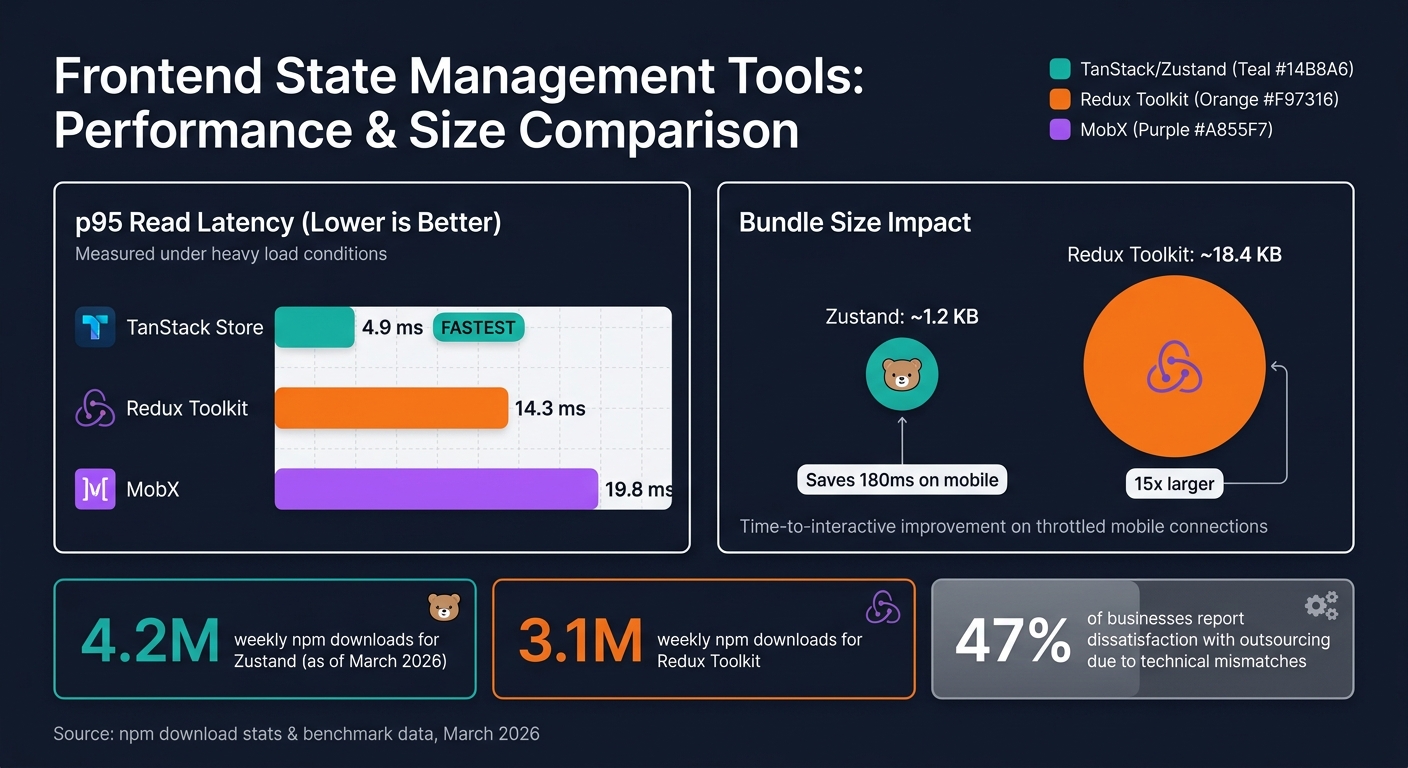
Pay attention to whether they match the tool to the task at hand. For example, using a heavyweight state management library for simple UI interactions can create unnecessary complexity. As of March 2026, Zustand has surged to 4.2 million weekly npm downloads, outpacing Redux Toolkit at 3.1 million – a clear reflection of modern trends in frontend development [12].
Another red flag to watch for is the absence of index.ts files in their state folders. Without these, you may find tight coupling between modules, which can lead to fragile systems where changes in one area unexpectedly break functionality elsewhere [1].
Once you’ve reviewed their code, shift your focus to how they approach architectural decisions.
Ask the Right Questions to Test Architecture Thinking
The best insights come from understanding why a partner made certain decisions, not just what they did. Ask them to explain their process for choosing a state management tool. A strong candidate will demonstrate a clear decision-making path, starting with simple options like useState and escalating to more advanced tools like Zustand or Redux Toolkit only when necessary [9][11].
"The single rule that prevents most bugs is ‘match the tool to the bucket.’" – Sujeet Jaiswal, Principal Software Engineer [2]
Dive deeper by asking about their approach to derived state. A knowledgeable partner will compute derived state rather than store it, using memoized selectors to avoid synchronization issues [1]. You can also pose practical scenarios, like structuring state for a multi-step checkout flow or managing a live dashboard with frequent updates. Their answers will reveal more about their expertise than a portfolio ever could.
Next, evaluate how their architectural choices hold up under real-world conditions.
Check Their Approach to Performance and Scalability
Performance is a crucial factor. Ask for profiling data or examples from past projects to see how they handle memoization, selector optimization, and real-time updates.
The numbers tell the story. For instance, under heavy load, TanStack Store achieves a p95 read latency of 4.9 ms, while Redux Toolkit averages 14.3 ms and MobX comes in at 19.8 ms [12]. This kind of data shows whether a partner prioritizes performance trade-offs over mere familiarity with tools. Bundle size also matters – Zustand’s lightweight ~1.2 KB package can reduce time-to-interactive by 180 ms on throttled mobile connections compared to Redux Toolkit’s heftier ~18.4 KB setup [10][12].
"TanStack Store uses a fine-grained subscription model borrowed from Solid’s reactivity. When you update one slice, only components subscribed to that exact slice re-render. Redux Toolkit still walks the entire reducer tree on every dispatch." – Tanner Linsley, Creator of TanStack libraries [12]
Finally, ensure they grasp hydration in complex environments. This includes syncing persistent state from localStorage or IndexedDB in server-side rendering (SSR) or React Server Component setups. If they can’t confidently explain how to prevent mismatches during hydration, that’s a critical gap to note [2][12].
Assess How a Partner Handles Delivery on Complex and Fragile Systems
Technical know-how alone doesn’t guarantee a partner can effectively manage fragile production systems. To gauge their capabilities, it’s essential to evaluate how they plan, test, and communicate under demanding conditions.
Find Out If They Can Stabilize and Refactor Existing Frontends
Before making any changes to a legacy system, a reliable partner should conduct behavioral tests. These tests act as a safety net, helping to prevent regressions. Without them, refactoring becomes little more than guesswork, which can lead to costly errors [15].
Another key approach is the Strangler Fig pattern, where the system is replaced piece by piece instead of attempting a full-scale rewrite. This method significantly reduces risk, especially since roughly 60% of frontend rewrites fail and often take three times longer than initially planned [14].
"The most important reason to consider a strangler fig application over a cut-over rewrite is reduced risk." – Martin Fowler [14]
Ask how the partner sequences their work. A disciplined approach involves replacing the data layer first, ensuring the user interface is built on a solid foundation [15]. Additionally, they should use feature flags for incremental deployment, allowing them to roll back changes instantly if issues arise with a refactored module [13][14].
Take the Red Hat Hybrid Cloud Console migration as an example. From July 2025 to March 2026, lead developer Riccardo Forina’s team spent two months writing behavioral specifications for the legacy system before writing any new code. They implemented 959 browser-based interaction tests, 207 end-to-end tests, and enforced strict module boundaries using automated lint rules. This preparation allowed them to remove 216 files from the old state management system in a single commit – without any production downtime [15].
Once you’ve assessed their stabilization methods, dive deeper into their testing strategies for state-heavy code.
Evaluate Their Testing Practices for State-Heavy Code
Managing complex state systems requires robust testing practices. Start by reviewing their test suite and coverage report. For production-grade React applications, 70% test coverage is considered the baseline [3]. However, the type of tests they use is just as important as the coverage percentage.
Top-tier partners prioritize integration tests over unit tests for state-heavy code. Integration tests render components with a real store instance, providing a clearer picture of how state flows through the application. In contrast, unit tests often focus on isolated reducers, which can miss critical issues [16][17]. Be wary of partners relying on redux-mock-store, as it can produce misleading results.
"Testing with a mock store leads to potentially confusing behaviour, such as state not updating when actions are dispatched." – Redux Team [17]
Also, ask about their approach to API mocking. Partners using tools like Mock Service Worker (MSW) to intercept calls at the network level test under conditions closer to real-world scenarios compared to those who mock hooks directly [16][18]. Lastly, find out how they manage "leaky" tests, where state from one test interferes with another. This issue is a frequent source of hard-to-diagnose failures in complex systems [16][19].
Testing alone doesn’t ensure success – collaboration across teams is just as vital.
Check How They Collaborate Across Teams
Frontend systems don’t operate in isolation. They rely on backend schemas, design decisions, and product requirements. Misalignment in any of these areas can create significant fragility. That’s why it’s crucial to understand how a partner handles cross-team collaboration.
Look for partners who adopt a contract-first integration approach. This means they work from stable, documented API contracts (such as OpenAPI specs or GraphQL schemas) instead of assuming backend consistency. Tools like Pact for consumer-driven contract testing can help catch misalignments between frontend and backend before they hit production [20].
Collaboration also depends on clear ownership roles. A dependable partner will define responsibilities such as a Technical Lead for architecture, an Agency Lead Dev for sprint coordination, and a Delivery Owner for managing budgets and escalations [21]. Without clear ownership, accountability gaps can arise, which are cited as the cause of 40% of outsourced team failures [21].
| Communication Layer | Channel | Purpose |
|---|---|---|
| Synchronous | Zoom / Slack (urgent) | Real-time architecture reviews and blockers |
| Asynchronous | Loom / Slack / GitHub | Context-heavy walkthroughs and code reviews |
| Reference | Wiki / Decision Log | Long-term context for team rotations |
Finally, ensure the partner commits to at least 4 hours of daily synchronous overlap with your team [21]. Complex systems with interdependent components suffer delays when communication is limited to asynchronous channels, leading to compounded inefficiencies.
These practices are essential for managing the intricate demands of your product’s state management and ensuring smooth delivery.
Use Practical Exercises and Discussions to Test a Partner’s Fit
Portfolios can give you an idea of a partner’s capabilities, but practical exercises reveal how they handle real-world challenges. These exercises complement the technical reviews and testing strategies discussed earlier.
Build a Technical Exercise Around a Flow from Your Own Product
Choose an actual workflow from your product – like a live dashboard, a multi-step onboarding form, or a table with sorting, filtering, and pagination. Then, ask the partner to model the state for that process. A solid partner will break the problem into distinct categories, using tools like TanStack Query for server state, Zustand for shared client state, and React Hook Form for form state. A less experienced candidate might resort to a single global store for everything, which can lead to inefficiencies.
Dive deeper by testing their troubleshooting skills. For example, present a broken component causing infinite re-renders and ask how they’d optimize both client and server components to reduce JavaScript payload. Evaluate how they handle various states in a critical user journey – like loading, success, empty, error, partial failure, and stale data.
"A candidate who merely recommends ‘using an arrow function’ without addressing re-render implications reveals outdated thinking." – Robert Ardell, KORE1
Ensure their definition of "done" includes thorough testing, accessibility checks, performance benchmarks aligned with Core Web Vitals (e.g., Interaction to Next Paint), and robust error handling.
"Every deliverable should have an acceptance check. If it cannot be checked, it is not a deliverable, it is a promise." – Wolf-Tech
Walk Through Your Architecture Together and Discuss Trade-offs
Share your actual frontend and backend architecture diagrams with minimal edits. A capable partner should be able to do three things: identify modules and entry points, trace data flows, and abstract key architectural patterns. If they struggle with this, it might indicate they’ll have difficulty navigating your system.
Encourage them to challenge your architectural decisions. Ask questions like, "Which parts of this architecture would you argue with?" or "Are there components I’ve merged that you would separate?" A strong partner will point out unclear state boundaries or shared modules that could cause dependency issues. Someone who agrees with everything without critique may not be evaluating critically.
Take it a step further by stress-testing your architecture. Walk through a failure scenario – like an external API returning a 503 error for 90 seconds. Ask them what breaks, what stays operational, and how the user experience is affected. This will reveal whether they think about resilience or only plan for ideal conditions.
Confirm Alignment on Tools, Processes, and Governance
Before committing, ensure the partner’s operational practices align with your needs. Verify they use automated CI/CD pipelines, such as GitHub Actions or Vercel, to make pull requests reviewable in a staging environment rather than just on local machines. Their updates should be incremental and manageable, not large, monolithic changes.
Ask about tools like Storybook, which allow for isolated component state reviews. This helps catch UI regressions and ensures state-heavy components are thoroughly tested. Also, confirm they have robust error tracking and observability in place, using tools like Sentry or Datadog.
"If the UI is a black box, you learn about problems from customer complaints. A modern front end should emit signals." – Wolf-Tech
Two governance practices are critical: using Architecture Decision Records (ADRs) to document why certain tools or patterns were chosen, and including a "Named Resources" clause in the contract to guarantee that the senior architects involved in early discussions are the ones writing the code. Without these measures, you risk architectural drift or bait-and-switch scenarios. Running a two-week paid pilot can help validate their communication, code quality, and process discipline before committing to a longer engagement.
Conclusion: Turning Your Evaluation into a Clear Decision
You’ve mapped state domains, tested candidates through real-world architecture exercises, and scrutinized their governance practices. Now, it’s time to turn all of that data into a clear, actionable decision.
Start by organizing your findings into a weighted scoring matrix. Focus on the dimensions most critical to your product’s stability – things like architectural thinking, performance literacy, testing discipline, and delivery governance. Assign each candidate a score from 1 to 5 in each category, multiply by its weight, and then calculate the total. If a candidate scores below 3.0 in high-priority areas like technical depth or state expertise, it’s a red flag worth serious consideration.
| Criteria | Weight | Red Flags | Green Flags |
|---|---|---|---|
| Architecture | 30% | Combining UI and server state in one "god" store | Clear use of ADRs, FSD, and defined state boundaries |
| Performance | 20% | "We’ll optimize at the end" | Performance budgets with LCP targets under 2.5s |
| Testing | 20% | Manual QA only; no state logic tests | Unit/E2E tests for critical state transitions |
| Governance | 15% | No repo access until project completion | Mandatory PRs, CI/CD, and regular team syncs |
| Technical Fit | 15% | Generic "web dev" experience | Specific React/Next.js complex state case studies |
This method ensures you’re making a decision rooted in data, not guesswork. It also helps you align your choice with your product’s current needs. For instance:
- Early-stage products may prioritize speed and modular architecture.
- Growth-stage products might need automated CI/CD and scalability.
- Enterprise-level products should focus on SOC 2 compliance and multi-tenant security.
The criteria you define should reflect the specific challenges your product is facing, not a one-size-fits-all checklist.
"The evaluation process is backwards. Companies spend 80% of their time evaluating the pitch and 20% evaluating the actual capability. It should be the opposite." – Social Animal [4]
If two candidates score similarly, consider a paid discovery phase. For $5,000–$15,000 over one to two weeks, ask the partner to deliver a technical plan and a state architecture map tailored to your product. This exercise will reveal their depth of understanding and ability to execute – far more effectively than any sales pitch ever could.
FAQs
How do I know which state ‘bucket’ my data belongs to?
To figure out which "bucket" your data belongs to, start by identifying where it originates and how it’s used. Here are some common buckets:
- Server State: This data comes from your backend and can become outdated over time.
- Local UI State: Data used exclusively within a single component.
- Shared Client State: This is shared data that multiple components rely on.
- URL State: Data tied directly to URL parameters.
Once you’ve classified your data, choose tools that align with its purpose. For instance, you might use React Query for managing server state or useState for handling local UI state. Matching the tool to the data’s behavior ensures smoother functionality.
What are the biggest red flags in a vendor’s state management approach?
When evaluating a vendor’s state management approach, certain warning signs should raise concern. Some of the most critical include:
- Hidden dependencies: These can make the system unpredictable and harder to debug, as components may rely on unseen or undocumented connections.
- Overly complex state models: An unnecessarily intricate state structure can introduce confusion, making it difficult for teams to understand and manage the system effectively.
- Poor architectural planning: A lack of foresight often leads to disorganized systems that are hard to scale or adapt over time.
Other common issues to watch for include:
- Implicit couplings: Components that are unintentionally tied together can create a fragile system prone to breaking when changes are made.
- Mixing unrelated concerns in one store: Combining unrelated data or logic within a single store can blur boundaries and complicate maintenance.
- Over-reliance on global state: While global state can be useful, relying on it too much can lead to inefficiencies and unintended side effects.
- Neglecting performance or scalability: Ignoring these aspects can result in systems that struggle under load or fail to meet future demands.
These red flags can lead to systems that are not just inefficient but also prone to bugs and difficult to maintain over time, making collaboration and long-term development far more challenging.
What should I include in a paid pilot to validate state management skills?
When assessing a potential frontend outsourcing partner, it’s important to gauge their ability to handle complex state management scenarios. One effective way is to include a task during the evaluation process that challenges them with intricate state situations, such as managing shared state or server state.
Pay close attention to their proficiency with popular libraries like Redux or Zustand. Look for how well they follow best practices and their ability to reduce unnecessary re-renders, which can significantly impact performance.
Additionally, observe their communication and documentation throughout the pilot project. Clear explanations and well-organized documentation are strong indicators that they can manage your product’s specific state management needs with precision and reliability.







Leave a Reply