Blog14 min read
54% of Companies Stopped Hiring Junior Devs Because of AI. Here’s the Crisis That Creates.
By Huzefa Motiwala · Co-Founder & Chief Product Officer

AI is reshaping the tech industry, but it’s creating a hiring crisis for junior developers.
- 54% of companies have reduced hiring for junior devs as AI tools like GitHub Copilot automate tasks traditionally assigned to entry-level engineers.
- Between 2022 and 2024, job postings for junior roles dropped by 60%, while juniors now make up only 7% of new IT hires (down from 15%).
- Companies save money with AI, but this shift risks breaking the talent pipeline, leading to a shortage of mid-level and senior developers in the future.
- Senior developers are overburdened, with 68% reporting burnout in 2024, and AI-generated code often requires extensive review due to errors and security vulnerabilities.
The long-term impact? A potential shortage of experienced engineers by 2032, rising salaries for senior roles, and weakened team structures. Startups and companies must rethink hiring strategies to balance AI efficiency with human expertise, ensuring they invest in junior talent to secure future leadership.
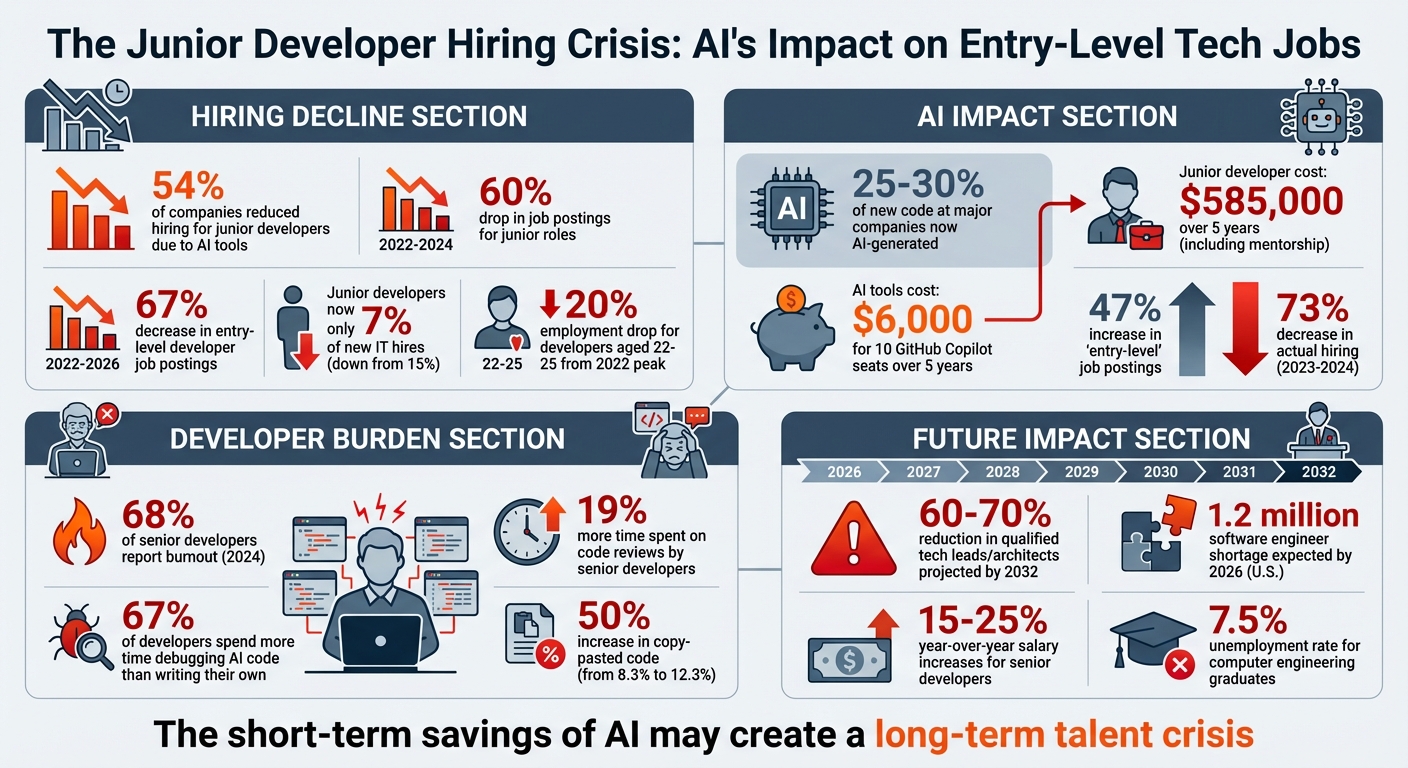
The Junior Developer Hiring Crisis: Key Statistics on AI’s Impact on Entry-Level Tech Jobs
The Numbers Behind the Junior Developer Hiring Drop
What the Data Shows About Junior Hiring
The drop in junior developer hiring has been both sharp and dramatic. Between 2022 and 2026, job postings for entry-level developer roles fell by an alarming 67% [6]. In just three years, the share of juniors and recent graduates in IT roles shrank by over half, effectively gutting the entry-level workforce [1].
The age group most affected paints an even clearer picture. Employment among software developers aged 22 to 25 dropped nearly 20% from its 2022 peak by July 2025. Meanwhile, computer engineering graduates now face a 7.5% unemployment rate - higher than even fine arts majors. Adding to the challenge, tech internships have decreased by 30% since 2023, even as applications per role have climbed by 7% [6][2].
A concept referred to as "signal collapse" highlights the growing disconnect between job postings and actual hires. For instance, between 2023 and 2024, postings for "entry-level" roles increased by 47%. However, actual hiring for these positions plummeted by 73%, as companies opted to fill these roles with senior developers instead [6]. At organizations leveraging AI tools, junior roles dropped by 23%, while senior positions increased by 14% [3]. These trends are reshaping traditional hiring pipelines, forcing companies to reconsider how they build their teams.
Why Employers Are Cutting Junior Positions
The data points to a clear financial motivation behind this shift. Hiring and supporting a junior developer can cost a company about $585,000 over five years when factoring in salary, benefits, and the 500 hours of senior mentorship typically required for training. In stark contrast, providing 10 GitHub Copilot seats over the same period costs just $6,000 [3]. With AI now capable of handling many routine coding tasks that juniors once managed, the business case for entry-level hiring has grown weaker.
"AI is eroding the ‘bottom rungs’ of career ladders by automating intellectually mundane tasks that junior employees typically handle." - Seyed M. Hosseini and Guy Lichtinger, Researchers, Harvard [3]
At some major companies, AI systems now generate 25% to 30% of all new code [3]. This shift means a senior developer equipped with AI tools can often replace the output of several junior developers. For example, in late 2023, Klarna implemented a complete hiring freeze for developers to test whether AI could eliminate the need for additional staff. Although the company eventually resumed hiring to address knowledge gaps and ensure system stability, the experiment underscored the risks of moving away from junior roles entirely [2].
This evolving dynamic presents a challenge, especially for startups trying to balance the integration of AI with the need to maintain a sustainable and knowledgeable team.
What Happens When Junior Roles Disappear
The Skills Gap: Developers Without Hands-On Experience
AI has taken over many repetitive tasks that used to serve as essential training for new developers. This shift means that many developers are now advancing to senior roles without the hands-on problem-solving experience they need. For example, debugging race conditions or optimizing production systems - skills once honed through direct practice - are becoming less common.
This has led to what some call the "Hollow Senior" phenomenon: developers who rely heavily on AI-generated solutions instead of tackling complex coding challenges themselves [8]. Without ever digging into tasks like tracking memory leaks or refactoring outdated codebases, these developers may find themselves unprepared when unexpected production issues arise.
The impact is clear in the numbers. AI-assisted coding has caused a nearly 50% increase in copy-pasted code, jumping from 8.3% to 12.3% of changed lines. Meanwhile, refactoring activity has dropped from 25% to below 10% [8]. This growing reliance on AI-generated code, often without full understanding, is creating a noticeable gap in practical experience, which could lead to a broader shortage of seasoned developers in the future.
The Coming Shortage of Experienced Developers
When junior developers miss out on foundational experience, the entire talent pipeline suffers. The data paints a worrying picture: a projected 67% drop in junior hiring is expected to lead to a 60% to 70% reduction in qualified tech leads and architects by 2032 [7]. Companies aiming to cut costs by slashing training budgets may be saving money in the short term but are inadvertently creating a structural talent gap [7][1].
"Cutting off the talent pipeline entirely creates a leadership vacuum in 5-10 years." - Addy Osmani, LeadDev [7]
The U.S. is on track to face a shortage of 1.2 million software engineers by 2026 [7]. As the pool of junior developers dries up, competition for experienced talent is heating up. Salaries for senior developers are climbing, with year-over-year increases of 15% to 25% [1]. As Matt Garman, CEO of AWS, aptly asked: "How’s that going to work when ten years in the future you have no one that has learned anything?" [6][8].
Senior Developers Carrying More Weight
The shrinking junior pipeline is putting extra pressure on senior developers. Without juniors to take on routine tasks, seniors are left to juggle everything - from high-level architectural decisions to mundane tasks like generating boilerplate code. One engineer described juniors as a "pressure valve" that has now disappeared [3][7].
Today, senior developers are spending 19% more time on code reviews than they did before AI tools became widespread [7].
"We used to call it an engineer, now it is like a reviewer. Every time it feels like you are a judge at an assembly line and that assembly line is never-ending, you just keep stamping those [pull requests]." - Siddhant Khare, Software Engineer [3]
At companies using AI tools, 67% of developers report spending more time debugging AI-generated code than writing their own [3]. This added workload is leading to burnout, and when senior developers leave, the cost to replace them can range from $100,000 to $200,000 per hire. Beyond the financial hit, companies also lose irreplaceable institutional knowledge [3][9].
The absence of junior developers also means that critical organizational knowledge - like system quirks, operational best practices, and company culture - has no one to pass down to. As a result, legacy systems risk becoming mysteries that no one fully understands [1].
How Startups Can Address This Challenge
Hire and Train Junior Developers While Using AI
A GitHub Copilot Enterprise license costs $468 per year, while a junior developer typically earns between $70,000 and $90,000 annually [4]. While the cost difference might seem stark, it’s important to think of training as a long-term investment rather than a short-term expense. This perspective shifts the focus from immediate productivity to building a skilled workforce for the future [10][1].
IBM offered a compelling example in early 2026. While many companies were scaling back on entry-level hiring, IBM went in the opposite direction under CHRO Nickle LaMoreaux, tripling its junior developer intake. The company restructured these roles so juniors spent less time on routine coding tasks and more on interpreting customer needs and validating AI outputs. As LaMoreaux stated:
"The companies three to five years from now that are going to be the most successful are those companies that doubled down on entry level hiring in this environment" [12].
To make this approach work, redefine what it means to be a junior developer. Instead of focusing on metrics like ticket velocity or lines of code - both of which AI can artificially inflate - consider measuring "learning velocity", or how quickly juniors progress from handling basic tasks to solving complex problems [8]. Create a "No-AI Sandbox" where juniors tackle low-stakes tasks without AI, helping them build problem-solving skills from the ground up. Additionally, implement reverse code reviews where juniors analyze AI-generated code line by line, explaining their reasoning. Struggles in these reviews can highlight areas where mentorship is needed [8][11].
A phased onboarding structure can also make a difference. Pair juniors with a buddy during their first three months, transition to pair programming with senior developers in months three to six, and then move them to independent module ownership by months six to twelve [1]. Allocate time for mentoring as part of senior developers’ responsibilities. Require juniors to annotate pull requests with notes explaining how they verified AI-generated code and their rationale for accepting or rejecting specific sections [8].
These steps not only prepare juniors for success but also create a more resilient talent pipeline that offsets the risks of over-reliance on AI.
Redesign Junior Roles to Work With AI
As startups invest in training, they should also rethink the junior developer role to fit an AI-driven environment. Traditional junior tasks - writing boilerplate code, cleaning data, or basic QA - are becoming less relevant. A new role is emerging: the "Apprentice Architect." This role focuses on reviewing and orchestrating AI-generated code, rather than just producing it [10].
The shift is already visible. Between 2023 and 2025, jobs for traditional "programmers" dropped by 27.5%, while roles like "software developer" with a design focus fell by only 0.3% [2]. The market is splitting between those who write code and those who design systems. While AI is great at automating repetitive tasks, it can’t replace the strategic thinking needed for system design.
To adapt, junior roles should focus on skills AI can’t replicate - debugging tricky issues like race conditions, designing systems, and translating customer requirements into technical solutions [11][12]. Juniors can act as the bridge between business needs and technical execution. With routine coding tasks handled by AI, their time can be spent on more impactful work.
Startups should also track meaningful metrics. For instance, measure "review depth" - how well juniors contribute during code reviews, rather than just approving changes with a quick "LGTM" (Looks Good To Me) [8]. Assess their ability to explain architectural decisions. Charity Majors, CTO of Honeycomb, emphasized the importance of this:
"By not hiring and training up junior engineers, we are cannibalizing our own future" [11].
Another key practice is assigning tasks that must be completed without AI assistance. This helps juniors develop the intuition they’ll need when AI tools fall short in high-pressure situations.
Use Fractional CTO Support for Hiring Strategy
Redefining roles is one thing, but refining hiring strategies requires an additional layer of expertise. Startups often struggle to balance long-term planning with the demands of daily operations. This is where external technical guidance can make a difference, offering the strategic perspective necessary to avoid decisions that could hurt the company down the road.
AlterSquare’s Principal Council Advisory provides this kind of support. Startups can tap into founder-led technical oversight to evaluate mentoring capacity, create 12-month development plans, and structure junior hiring for sustainable growth [1]. The advisory team - featuring experts like Taher, Huzefa, Aliasgar, and Rohan - uses its experience in system stabilization to identify acceptable levels of technical debt and areas that need immediate attention.
This guidance is especially important because AI-generated code still requires human oversight [1]. A fractional CTO can design hiring strategies that balance AI efficiency with human judgment, ensuring the talent pipeline remains strong [8][11].
The service starts at $3,000 per month and provides the foresight needed to avoid costly mistakes. For example, in late 2023, Klarna paused developer hiring to capitalize on AI efficiencies. By 2025, the company had to resume hiring after realizing it lacked the human expertise needed for complex tasks and decision-making [4][2]. Engaging a fractional CTO helps startups avoid similar pitfalls, ensuring their teams are prepared to thrive in an AI-driven world.
The Hidden Costs of Skipping Junior Hiring
Weak Teams and Lost Knowledge
Cutting junior roles might save money in the short term, but it creates long-term problems. Senior developers are now spending 19% more time on code reviews than they did before AI tools became widespread. This shift adds to their already heavy workload [7]. Without juniors to manage simpler tasks like unit testing and basic refactoring, seniors are left juggling complex projects alongside reviewing large amounts of AI-generated code. This imbalance not only wears them down but also hampers overall productivity.
Another critical issue is knowledge transfer. When seniors mentor juniors, they pass along more than just coding skills - they share insights about the organization, its architecture, and the unwritten rules that make things run smoothly. Without juniors to mentor, much of this knowledge disappears over time [1]. As a result, the codebase suffers; without clear reasoning behind key decisions, maintenance becomes harder. For example, copy-pasted code has surged by almost 50% [8], contributing to technical debt that will eventually demand costly fixes. These challenges don’t just affect today’s teams - they ripple into the future, weakening team structures over time.
Falling Behind in the Talent Market
The lack of junior hiring doesn’t just hurt internal operations; it also damages a company’s position in the broader talent market. Without a steady pipeline of junior talent, businesses risk creating a "missing generation" of mid-level and senior engineers by the 2030s. Between 2022 and 2025, employment for developers aged 22-25 dropped nearly 20%, and the proportion of juniors in new IT hires fell from 15% to just 7% [5][1].
This shrinking pool of junior talent could lead to fierce competition for experienced engineers down the line. In fact, wages for specialists are already climbing, with increases of 15-25% year-over-year [1]. Investing in juniors now is far more cost-effective than trying to hire mid-level developers later. For instance, bringing on a junior at $50,000 and helping them grow into a mid-level role worth $75,000 in two years is a smarter financial move than paying inflated market rates for someone already at that level. Companies that prioritize junior hiring can build a team of skilled, loyal engineers, while those that don’t may find themselves scrambling - and paying a premium - to fill essential roles in the future.
Will AI Replace Junior Developers? The Hidden Risk for Agile Teams
Conclusion: Building Teams That Last in an AI-Driven World
AI is undeniably a game-changer, but nurturing engineers who can think critically, debug intricate systems, and lead teams is just as crucial. Companies that commit to developing strong junior talent pipelines today - despite AI’s appeal for efficiency - set themselves up for long-term success. Hiring a junior developer at around $70,000 is more than just a cost; it’s an investment in the leaders of tomorrow. That junior hire could grow into a pivotal team leader by 2031 [4]. As Matt Garman, CEO of AWS, aptly said:
"How’s that going to work when ten years in the future you have no one that has learned anything?" [8]
The data makes it clear: skipping out on junior hiring today risks leaving a void in experienced leadership down the line. Striking a balance between leveraging AI and cultivating human expertise is critical for startups navigating the complexities of an AI-driven future.
To maintain this balance, use AI for repetitive tasks while creating "No-AI Sandboxes" where junior developers can sharpen their problem-solving abilities [8]. Allocate 20-30% of senior engineers’ time to mentorship and track junior developers’ growth by the increasing complexity of the challenges they can tackle.
FAQs
How can junior developers get real experience if AI does the easy tasks?
Junior developers can grow their expertise by honing skills that AI can’t easily replicate. Areas like system architecture, advanced problem-solving, and grasping complex project requirements stand out as key focus points. Getting involved in open-source projects, working collaboratively on system design, and addressing practical challenges can help sharpen these abilities. These efforts highlight creativity, mentorship, and a deep understanding of user needs - things AI struggles with - allowing juniors to advance beyond just routine coding tasks.
What should a junior dev do now in an AI-first team?
Junior developers should aim to develop skills that work hand-in-hand with AI tools instead of trying to outperform them. Focus on areas where AI falls short, like problem-solving, critical thinking, and understanding intricate systems.
Mastering how to collaborate with AI can significantly enhance your productivity and keep your skills current. Additionally, building soft skills such as communication and flexibility will help you succeed in ever-changing workplaces and prepare you for more strategic opportunities as your career progresses.
How do startups hire juniors without overloading senior engineers?
Startups are finding ways to handle junior hiring without overwhelming their senior engineers. One approach is leveraging AI tools to take care of repetitive tasks like boilerplate coding and documentation. By automating these duties, senior developers can avoid spending excessive time on supervision.
Additionally, startups are rethinking how they train new hires. They’re implementing structured onboarding programs, encouraging peer learning, and using AI-driven training platforms to simplify mentorship. These efforts allow teams to grow while keeping the workload for senior engineers manageable.