
Every Startup Has Tech Debt. The Ones That Die Are the Ones That Pretend They Don’t.
Taher Pardawala March 2, 2026
Every startup has tech debt. Ignoring it is the real problem. Shipping code quickly to test ideas often means cutting corners, but failing to manage those shortcuts can lead to costly issues later. Here’s the key takeaway: Tech debt is a tool, not a flaw. Use it wisely to move fast, but pay it down before it cripples progress.
- What is tech debt? It’s the trade-off between speed and long-term code quality. Think of it as a loan – you gain speed now but must "repay" through refactoring later.
- Why startups take it on: Early-stage companies prioritize speed over perfection to validate ideas.
- The danger: Untracked or unmanaged debt grows over time, making updates slow, bugs frequent, and rewrites inevitable.
- Types of tech debt:
- Intentional: Conscious shortcuts for speed.
- Accidental: Messy code from rushed decisions or lack of experience.
- AI-related: Fragile systems from relying too heavily on AI-generated code.
Key insights:
- Early stages: Use debt to move fast but avoid shortcuts on critical systems like security or financial models.
- Growth phase: Dedicate 15%-25% of sprints to reducing debt, focusing on problem areas.
- At scale: Harden infrastructure and minimize new debt to prepare for enterprise demands.
The bottom line: Successful startups don’t avoid tech debt – they manage it. Track it, prioritize fixes, and address it before it becomes a crisis.
Types Of Technical Debt And How To Manage Them
sbb-itb-51b9a02
What Tech Debt Actually Is
In the fast-paced world of startups, ignoring tech debt can be far riskier than addressing it. Technical debt is essentially a trade-off: sacrificing long-term maintainability for short-term speed. Think of it as a loan – you gain immediate benefits, but repayment (in the form of refactoring) is inevitable.
The key here is intent. Technical debt arises from deliberate choices, not from carelessness. For instance, hard-coding a feature to quickly test market fit is a conscious decision to take on tech debt. On the other hand, writing messy, disorganized code ("spaghetti code") due to inexperience isn’t tech debt – it’s just poor engineering. Ward Cunningham, one of the authors of the Agile Manifesto, captured this concept with a powerful metaphor.
Ward Cunningham’s Original Metaphor
Cunningham compared shipping early code to taking on financial debt. A small loan can speed up progress, but only if there’s a plan to pay it back. The real danger isn’t the initial debt – it’s the "interest" that builds up over time if the debt remains unpaid.
"Shipping first-time code is like going into debt. A little debt speeds development so long as it is paid back promptly with refactoring. The danger occurs when the debt is not repaid." – Ward Cunningham, Author of the Agile Manifesto
When tech debt isn’t managed, the consequences can spiral. A feature that should take two days to update might end up taking four. Bug fixes can become massive undertakings. Eventually, the system may become so fragile that a complete rewrite is unavoidable.
Why Startups Take On Tech Debt
For startups, tech debt isn’t the enemy – it’s denial of it that causes problems. Founders often see tech debt as a tool to gain speed, especially when time is of the essence. Early-stage companies have limited resources and tight timelines, so shipping quickly often takes priority over perfect code. After all, the bigger risk isn’t messy engineering – it’s building something no one wants.
A cautionary tale comes from Knight Capital Group. In August 2012, the firm lost $440 million in just 45 minutes due to a legacy code deployment error. This catastrophic failure, rooted in unmanaged tech debt, led to the company’s acquisition [5]. The lesson? The issue isn’t taking on tech debt – it’s failing to manage it properly.
Smart founders approach tech debt strategically. They take calculated shortcuts where it won’t hurt – like UI frameworks, admin tools, or superficial features – while being extra careful with critical elements such as core data models, financial ledgers, and security [1]. For example, Texture initially used RedwoodJS and prebuilt Tailwind components to launch their dashboard quickly. This was a deliberate choice to save time. Later, as they scaled, they "repaid" that debt by rebuilding the dashboard with a robust design system.
Not all tech debt is created equal. Understanding the types of debt and their potential impact helps founders decide which shortcuts are worth taking and which could cause long-term headaches.
3 Types of Tech Debt Founders Need to Track
Managing tech debt is crucial for startups, but it’s not inherently bad. The real danger lies in ignoring or mishandling it. Tech debt comes in three primary forms: deliberate shortcuts, unnoticed buildup, and issues stemming from AI-generated code. Let’s break them down and explore how to handle each type effectively.
Intentional Tech Debt: The Shortcuts You Choose
Intentional tech debt is the kind you consciously take on. Think of it as a calculated risk to test ideas quickly. For example, you might hard-code a feature to gauge user interest, use pre-made UI components instead of building custom ones, or stick with a simpler hosting solution until compliance demands something more robust.
The trick to keeping this under control? Visibility. Document every shortcut. Whether it’s adding clear TODO comments in your code, updating an Architecture.md file, or maintaining a debt register, you need a record of what was done, why, and how to fix it later. Without this, intentional debt can easily morph into accidental debt.
"If you have zero technical debt, you are probably moving too slow." – Ewelina Lech, Pragmatic Coders [2]
The right time to repay this debt is when the "interest" – like slower development, bugs, or frustrated team members – starts outweighing the initial speed boost. While this type of debt is manageable with proper tracking, unplanned debt often sneaks in unnoticed.
Accidental Tech Debt: The Hidden Buildup
Accidental tech debt happens unintentionally. It often stems from incomplete knowledge, rushed decisions, or team turnover. You’ll see it in messy code – perhaps from junior developers learning on the job, inconsistent solutions to similar problems, or overlooked security flaws that surface during an audit.
This debt usually stays hidden until it becomes a bottleneck. You might notice it when small changes take too long, regression bugs pile up, or developers feel like they’re constantly wrestling with the codebase. A common symptom? Simple updates requiring an outsized effort.
To tackle this, allocate 10% to 20% of each sprint for maintenance and addressing tech debt. Focus on the "hot paths" – the critical areas of your codebase that cause the majority of issues. As startups increasingly adopt AI tools, a new kind of tech debt is emerging that requires attention.
AI-Accelerated Tech Debt: The Speed Trap
AI-accelerated tech debt is relatively new but can be particularly tricky. Tools like Copilot or ChatGPT can churn out code that looks polished and passes tests, yet often introduces fragile or poorly integrated systems. As Victor Quinn, CTO of Texture, describes it, AI works like an "Infinite Intern" – quick and eager but lacking contextual understanding [6].
A study tracking six codebases over a year showed some concerning patterns with AI adoption. Duplicate code ratios jumped from 3.1% to 14.2%, average file sizes nearly doubled, and cyclomatic complexity increased from 4.2 to 8.1 [7].
The issue isn’t AI itself but relying on it without sufficient oversight. AI-generated code often reflects general training data rather than the specific needs of your project. It might add unnecessary libraries or create inconsistent error-handling approaches. To mitigate this, require developers to explain AI-generated code during reviews. If they can’t clearly articulate its purpose, it shouldn’t make it into production. Tools like jscpd can also help identify duplicate code, which is often a red flag for AI-related debt.
"Every line of code is a loan against our future. Let’s make sure the robot isn’t borrowing in our name without checking the interest rate." – Victor Quinn, CTO, Texture [6]
How Much Tech Debt You Should Have at Each Stage
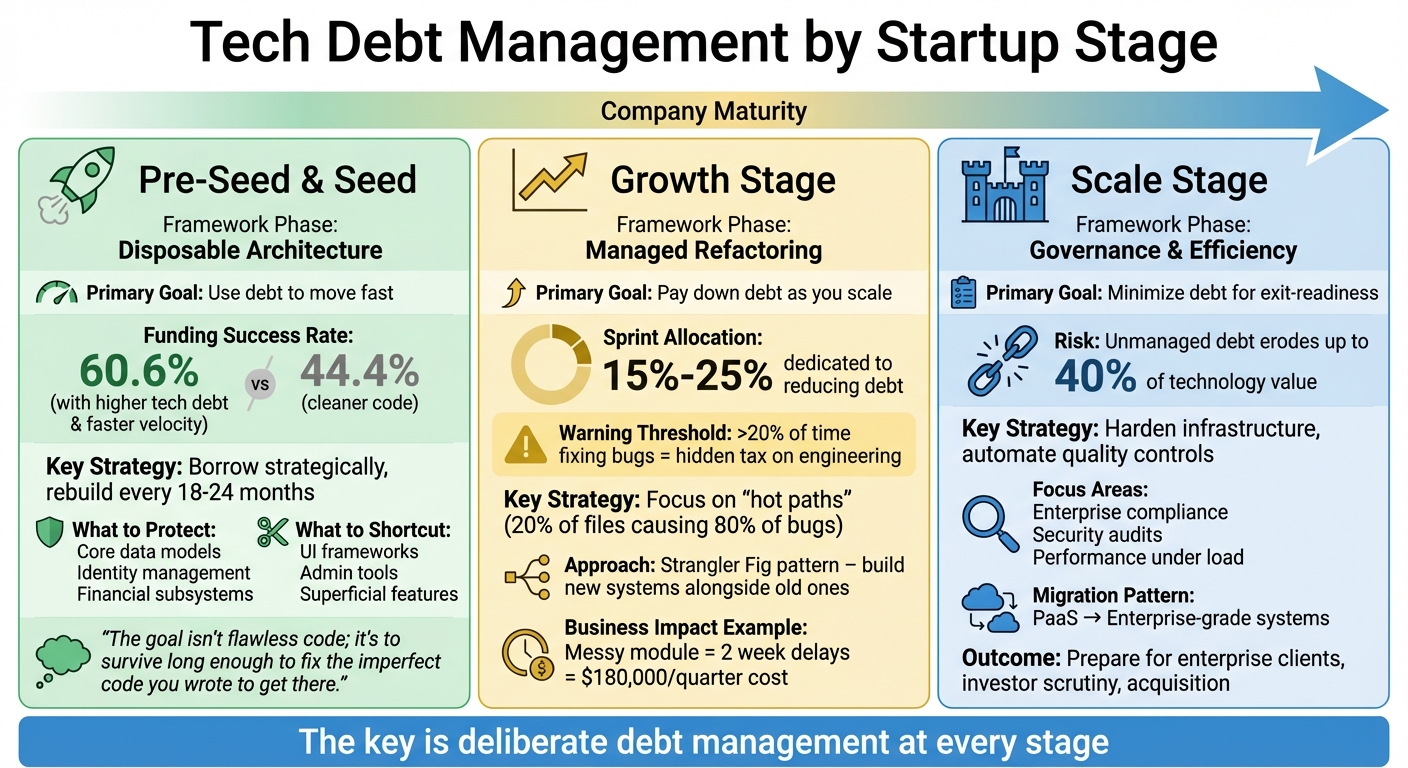
Tech Debt Management Strategy by Startup Stage
Tech debt isn’t a one-size-fits-all concept – it evolves as your startup grows. What might be helpful in the early days can become a major obstacle later. The key is knowing when to take on debt, when to pay it down, and when to avoid adding more altogether.
AlterSquare‘s Variable-Velocity Engine (V2E) framework adapts to your growth. Early on, you rely on a Disposable Architecture to move quickly. As you scale, Managed Refactoring keeps things running smoothly, and at maturity, the focus shifts to Governance & Efficiency for enterprise readiness.
Pre-Seed and Seed: Use Debt to Move Fast
At this stage, survival is your priority. The biggest risk isn’t messy code – it’s building something no one wants. Taking on tech debt can fuel the speed you need to compete. Startups with higher tech debt and faster velocity have a funding success rate of 60.6%, compared to 44.4% for those with cleaner code [10].
"The goal isn’t to write flawless, infinitely scalable code from day one; it’s to survive long enough to have the luxury of fixing the imperfect code you wrote to get there."
– Mehmet Kurtipek, CTO, Smart-Maple [8]
However, even in the early days, some parts of your system need to be rock solid. Avoid shortcuts on your "load-bearing beams" – core systems like data models, identity management, or financial subsystems. For instance, one fintech startup learned this the hard way when a poorly designed money-movement system left the team scrambling to reconcile funds with custom scripts months later [1].
For everything else, borrow strategically. Use pre-built tools, hardcode features to test ideas, and lean on frameworks that help you ship quickly. Keep a debt register to document shortcuts so you can address them later. Victor Quinn, CTO at Texture, did just that by using RedwoodJS and Tailwind UI components to rapidly validate their dashboard’s market fit [1].
The Disposable Architecture approach assumes you’ll rebuild or refactor core components every 18–24 months as your product evolves. In this phase, intentional debt is a tool to help you move fast [1].
Once your product finds market fit, the focus shifts to reducing debt and building stability.
Growth Stage: Pay Down Debt as You Scale
When your product starts gaining traction, tech debt can shift from being an asset to becoming a burden. If your team spends over 20% of their time fixing bugs or dealing with unstable code, you’re effectively paying a hidden tax on your engineering resources [3][11]. The issue isn’t tech debt itself – it’s when it’s unmanaged.
This is where Managed Refactoring comes in. You don’t need to stop everything to rewrite your codebase. Instead, dedicate 15% to 25% of each sprint to reducing debt. Focus on the "hot paths" – the 20% of files or modules responsible for 80% of your bugs and performance issues [2][9].
Refactor based on business needs rather than arbitrary timelines. For example, Texture switched from Render to AWS when enterprise customers required compliance tools that integrated better with AWS, cutting SOC 2 audit costs by 7× [1]. This milestone-driven approach ensures refactoring aligns with your company’s goals.
Another effective strategy is the "Strangler Fig" pattern, where you build new systems alongside old ones and gradually shift traffic to the new implementation [11][12][13]. When advocating for debt reduction, frame it in business terms. Instead of saying, "This module is messy", explain, "This module delays every feature by two weeks, costing $180,000 per quarter" [13].
Scale Stage: Minimize Debt for Exit-Readiness
At scale, every new line of code should strengthen your foundation. Unmanaged tech debt at this stage can become a liability, blocking enterprise deals, derailing security audits, or failing under heavy user loads [4][1]. The focus now is on hardening infrastructure, implementing governance frameworks, and avoiding unnecessary debt.
This often involves migrating from developer-friendly PaaS solutions to enterprise-grade systems that meet compliance and performance standards. Automate quality controls in your CI/CD pipelines to ensure pull requests meet coverage and complexity requirements [8][9].
For example, Texture transitioned from a rapid deployment solution to a design system built on Next.js, preparing their platform for enterprise demands [1].
"Technical debt is exactly like financial debt. It’s not moral. It’s not a sin. It’s a tool. Used well, it gives you leverage. Used poorly, it slowly kills you."
– Victor Quinn, Co-founder and CTO, Texture [1]
Without proper management, tech debt can erode up to 40% of a company’s technology value [8]. At this point, the Governance & Efficiency phase ensures your systems are robust enough for enterprise clients, investor scrutiny, or even acquisition. The amount of debt you should carry depends entirely on where your company is in its lifecycle.
Conclusion
Technical debt isn’t the villain – ignoring it is. Every startup accumulates debt, whether it’s the intentional shortcuts taken to move quickly, the unplanned mess from shifting requirements, or the growing clutter from AI tools copying outdated patterns. The difference between startups that thrive and those that struggle isn’t a spotless codebase. It’s about knowing what you owe, where you cut corners, and addressing it before the costs spiral out of control.
Each type of technical debt demands a tailored approach, and your strategy should shift as your startup grows. In the pre-seed and seed stages, it’s all about speed and learning – don’t worry about perfect architecture. During the growth phase, set aside 15% to 25% of each sprint to tackle blockers that slow development. At scale, focus on reducing new debt and strengthening your infrastructure to meet enterprise standards and prepare for potential exits.
The most successful founders understand this delicate balance:
"The ones that win aren’t the ones with zero technical debt. They’re the ones that take it on intentionally, in the right places, and then pay it down ruthlessly before the interest gets crushing."
– Victor Quinn, Co-founder and CTO, Texture [1]
If you can’t track it, you can’t manage it. Set clear triggers – like noticing that small changes now take twice as long – to ensure you address debt before it snowballs into a crisis [15]. The cost of ignoring it is steep: countless startups lose valuable engineering bandwidth just trying to maintain fragile systems [14].
The key is deliberate debt management. Aim for progress, not perfection. The startups that succeed won’t necessarily have the cleanest codebases – they’ll be the ones that manage their debt wisely [4].
FAQs
How do I know if tech debt is hurting us?
Tech debt starts to cause problems when it hampers development speed, leads to more bugs, or prevents your system from scaling effectively. Common red flags include spending too much time fixing recurring issues, outdated systems that obstruct progress, or poorly documented and disorganized debt. The good news? If your team actively tracks and prioritizes tech debt, its impact can be managed. In the early stages, a bit of tech debt might actually help you move faster, but if left unchecked, it will eventually slow your startup’s momentum.
What kind of tech debt should we avoid early?
Avoid accumulating untracked or unmanaged tech debt in the early stages of your startup. This kind of debt can sneak up on you, eventually turning into a major roadblock. It can slow down your ability to release features, track progress, and make quick adjustments. Make it a point to document and actively manage your tech debt so it doesn’t become a hidden issue that hampers your growth.
How do we review AI-generated code safely?
When working with AI-generated code, it’s essential to approach it cautiously, treating it as untrusted until it’s thoroughly reviewed. A smart way to handle this is by using a multi-step process that includes extensive testing, validation, and security checks.
One golden rule: never push AI-generated code directly into production without a detailed review. AI tools, while helpful, can overlook vulnerabilities, making human oversight absolutely necessary. Pay close attention to how the code behaves, confirm that security measures are in place, and insist on clear evidence that the code functions as expected. This ensures it meets your standards before giving it the green light.








Leave a Reply